When we imagine prehistoric music, we often think of crude rhythms or simple vocalizations. But one astonishing archaeological find tells a very different story—one of remarkable craftsmanship, acoustic beauty, and an early, perhaps even spiritual connection to music.
In the Hohle Fels cave of southern Germany, archaeologists unearthed flutes carved from vulture and mammoth bones dating back 42,000 to 43,000 years. These beautifully made instruments suggest that music was already a deeply embedded part of early Homo sapiens’ culture. One of them, a mammoth-bone flute, reveals particularly sophisticated workmanship – no small feat given the tools available during the Upper Paleolithic period.
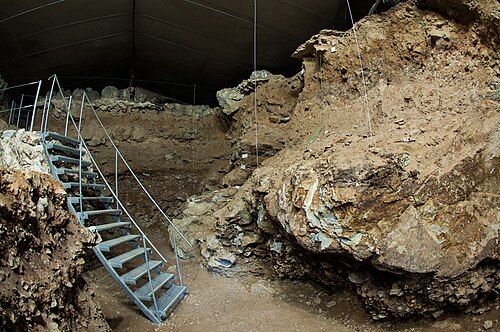
But perhaps even more intriguing is the so-called Neanderthal Flute, discovered in 1995 at a site called Divje Babe in modern-day Slovenia. Archaeologist Ivan Turk found the artifact – a cave bear femur with four precisely placed holes—in a Neanderthal campsite. This remarkable object may be over 43,000 years old, with some estimates placing it as far back as 80,000 years.
If indeed the work of Neanderthals, this flute challenges long-held assumptions that our closest evolutionary relatives lacked artistic or musical sensibilities. Musicologist Bob Fink has noted that the instrument’s four holes correspond closely to a diatonic scale – the very foundation of Western music (Do-Re-Mi…).
To test its musical possibilities, the Slovenian National Museum commissioned a clay replica. What emerged was truly astonishing.
Slovenian musician Ljuben Dimkaroski plays this replica in a spellbinding video performance. The flute’s voice is mesmerizingly beautiful – not primitive or raw, as one might expect from a Paleolithic artifact, but clear, high-pitched, and hauntingly lyrical. Dimkaroski demonstrates its expressive range by performing passages from Beethoven, Verdi, Ravel, and Dvořák, alongside bird-like improvisations and animal-like effects that highlight the instrument’s astonishing flexibility.
According to Dimkaroski, the flute’s playing technique came to him in a dream—a poetic twist that mirrors the mystery of its origins.
While some archaeologists remain skeptical about whether Neanderthals crafted this instrument, most agree that it was shaped by human hands—not animals or nature. If so, the Divje Babe flute may stand as the earliest known evidence of music-making in human history, and possibly a sign that Neanderthals shared more with us than we ever imagined.
Regardless of its precise origins, the Divje Babe flute offers a powerful reminder: music is ancient – older than writing, agriculture, or civilization itself. And it has always, it seems, had the power to move us.
Watch the performance and hear the voice of our ancient ancestors here: