When we speak of “difficult” flute repertoire, what do we really mean?
Some pieces challenge our technique, with dizzying runs, complex rhythms, and extended techniques that defy traditional sound production. Others challenge us musically — asking us not to play faster or louder, but deeper, simpler, and more honestly. And then there are works that do both.
In this article, we explore ten pieces that belong to the pantheon of flute challenges — repertoire that tests the limits of the instrument and the musician behind it. Whether you’re a professional flutist, teacher, or advanced student, these works are milestones — some you may fear, some you may love, and all you will remember.
1. Mozart – Flute Concertos in G Major, K.313 & D Major, K.314
Musically the most difficult of all.
These works are often among the first concertos studied by young flutists — and yet, paradoxically, they remain some of the hardest to play well. Their apparent simplicity is deceptive. Mozart exposes every flaw in tone, intonation, phrasing, and musical maturity.
There is no ornamentation to hide behind, no dense accompaniment to blend into. Each note demands purity, elegance, and restraint. To perform these concertos with clarity and depth requires not only years of training but also wisdom, style, and emotional refinement.
🎧 Recommended listening: Emmanuel Pahud with Claudio Abbado – for exquisite phrasing and transparency.
2. Joaquín Rodrigo – Concierto Pastoral
One of the most technically punishing flute concertos ever written.
Commissioned by and written for Sir James Galway in 1978, this concerto is a high-altitude adventure filled with fast articulations, wide intervallic leaps, double-tonguing, extreme range, and relentless pacing. Very few flutists have performed it — not because it’s obscure, but because it’s terrifying.
The work combines Spanish flair with brutal athleticism. If Mozart demands poise, Rodrigo demands fire.
🎧 Recommended listening: James Galway, who premiered the work and remains its fiercest champion.
3. Luciano Berio – Sequenza I (1958)
A psychological and physical solo endurance test.
This piece feels like a conversation with yourself — breathless, fragmented, and intensely expressive. It challenges the flutist’s rhythmic imagination, phrasing control, and breath endurance. It uses graphic notation that gives the player some interpretive freedom — and with that freedom comes great responsibility.
🎧 Recommended listening: Sophie Cherrier’s recording offers both precision and rawness.
4. Pierre Boulez – Sonatine for Flute and Piano (1946)
A modernist monster for flute and piano duo.
This early Boulez work blends Webern-like precision with fiery expressionism. It is intensely difficult rhythmically, harmonically, and pianistically. Both players must operate like synchronized machines — but with flexibility and color. Few works are as feared or respected in the flute-piano repertoire.
🎧 Recommended listening: Severino Gazzelloni with Dave Stuart on the piano.
5. Elliott Carter – Scrivo in Vento (1991)
Written as a musical ‘essay’ in the wind — and nearly impossible to memorize.
Inspired by a poem by Petrarch, this work features Carter’s signature metric modulation, where tempo constantly shifts in subtle ways. The piece feels like a brain teaser set to music. Every phrase requires rhythmic vigilance and interpretive commitment.
🎧 Recommended listening: Denis Bouriakov’s interpretation captures both the logic and lyricism.
6. Olivier Messiaen – Le Merle Noir (The Black Thrush, 1952)
A masterpiece of bird song and mysticism.
Written for the Paris Conservatory entrance exams, this short but rich piece fuses elements of French Impressionism, free rhythm, modal harmony, and birdsong transcription. It requires an acute sensitivity to time, space, and tone color. One of the earliest pieces to integrate Messiaen’s passion for ornithology.
🎧 Recommended listening: Davide Formisano’s rendition is lyrical and spiritually charged.
7. Kazuo Fukushima – Mei (1962)
Breath becomes music.
A landmark in East-West fusion and one of the most important works in the solo flute repertoire of the 20th century. Mei (translated as “Meditation”) draws on traditional Japanese aesthetics and techniques such as pitch bends, airy sounds, and pauses as expression. It’s minimal on the page, but emotionally vast.
🎧 Recommended listening: Peter-Lucas Graf’s performance is especially nuanced and meditative.
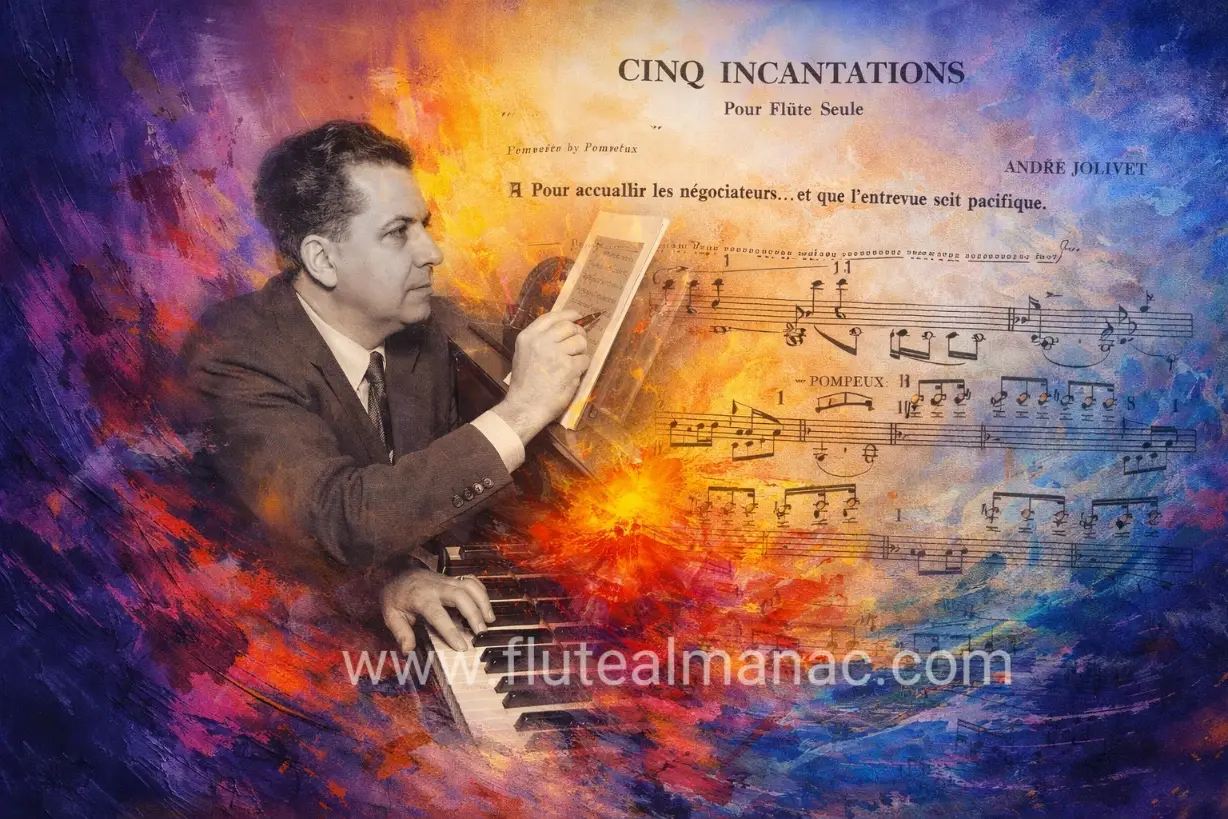
8. André Jolivet – Chant de Linos (1944)
A ritual lament turned into a modern masterpiece.
Blending lyrical Greek funeral song with warlike bursts, Chant de Linos demands technical mastery (flutter tonguing, extreme dynamics, modal runs) and expressive depth. Its pacing and unpredictability challenge even seasoned performers. A favorite in competitions — and a nightmare to perfect.
🎧 Recommended listening: Paolo Taballione’s live performance remains iconic.
9. Edgard Varèse – Density 21.5 (1936)
Perhaps the most influential solo flute piece of the 20th century.
This piece was revolutionary — written for the debut of the platinum flute (hence 21.5, the density of platinum). With no bar lines and frequent dynamic contrasts, the work feels architectural in its shaping of space and sound. It requires total control of tone, attack, color, and time.
🎧 Recommended listening: Claire Chase’s performance is a masterclass in modern flute color.
10. J.S. Bach – Partita in A minor, BWV 1013
The eternal test of musical integrity.
This unaccompanied Partita is one of the most studied and feared works in the flute canon. It tests breath control, articulation, memory, stylistic fluency, and mental pacing. While not as outwardly “flashy” as modern works, it is one of the most profound pieces ever written for the instrument.
🎧 Recommended listening: Barthold Kuijken for historically informed purity; Sasha Grot’s live performance for modern elegance.
Final Thoughts
What makes a piece difficult is not only what’s on the page — it’s also what the piece demands of the performer as a whole human being: technician, artist, storyteller, and thinker.
Whether you are working toward mastering these works or simply admire them from afar, they represent the mountain peaks of the flute repertoire — worthy of respect, fear, and love.