What if playing a flute didn’t require breath, keys, or even a traditional instrument – just the expressive movements of your mouth?
An astonishing new instrument, the Zen Flute, has redefined what it means to “play” a wind instrument. Winner of the 2023 Guthman Musical Instrument Competition at Georgia Tech, this mouth-controlled electronic device merges ancient principles of resonance with cutting-edge digital technology.
Created by experimental instrument designer Keith Baxter, the Zen Flute is not a flute in the classical sense, but it shares something essential with the instrument we know so well: it transforms subtle gestures of the mouth into expressive musical phrases.
A Flute Without Wind
At its heart, the Zen Flute is a forced Helmholtz resonator – a feedback loop built from a small speaker and microphone placed near the user’s mouth. Your oral cavity becomes the resonator, with pitch controlled by minute movements of the tongue, jaw, and lips. These changes alter the resonant frequency detected by the microphone, which is then interpreted by a Teensy 4.1 microcontroller.
The result? A powerful and breath-free tool for musical expression.
Much like a theremin or trombone, the Zen Flute doesn’t deal in fixed notes. The player “bends” the pitch manually, gliding between tones with incredible nuance. To translate this into a digital environment without losing its fluid character, the Zen Flute uses MIDI Polyphonic Expression (MPE) – a modern MIDI protocol that captures pitch slides, timbral shifts, and velocity with remarkable detail.

Design Meets Expression
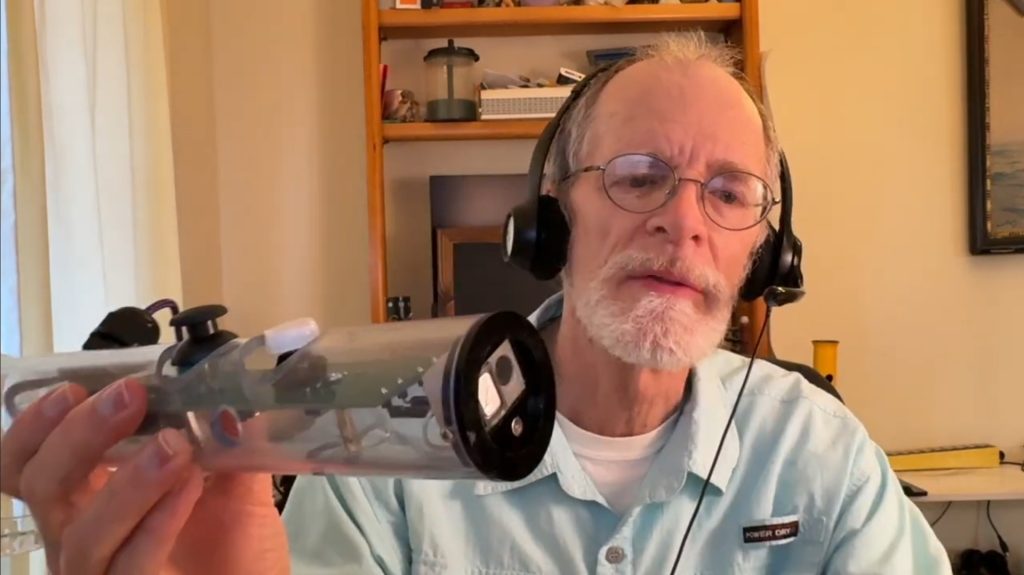
Physically, the instrument is sleek and futuristic. A flat speaker and mic sit at one end, separated by a custom silicone insert to prevent feedback. This assembly connects to a clear PVC pipe with a subtle bell flare, echoing the look of a traditional wind instrument.
Internally, a custom-printed circuit board handles audio amplification, mic preamplification, and pitch detection. A joystick enables the performer to switch between different instrument profiles, change timbre, or assign various MIDI channels. A push-button triggers the beginning of each note—an elegant nod to articulation in traditional wind playing.
The Zen Flute can connect directly to an external synthesizer or computer via USB, sending expressive MIDI data or audio signals to software instruments. It also supports onboard sound synthesis through tools like Faust.
A New Category of Instrument
The Zen Flute belongs to a small but growing family of mouth-controlled digital instruments, where musicality is driven by oral gestures rather than air or embouchure. These experimental designs push the boundaries of traditional music-making and provide a fascinating option for flutists, electronic musicians, and sound explorers alike.
Its expressive capabilities, breathless playability, and cross-platform MIDI compatibility make it particularly interesting for:
- Electroacoustic composers
- Live-looping performers
- Accessibility-focused musicians
- Flutists interested in contemporary extended techniques
Why It Matters to the Flute Community
Although the Zen Flute lacks tone holes and doesn’t require air, its performance philosophy aligns deeply with that of traditional flute playing: the shaping of sound through subtle physical control, the exploration of color and nuance, and the pursuit of continuous expression.
It also opens doors to new musical collaborations between acoustic flutists and digital artists, offering a futuristic “voice” that can complement and extend the expressive range of the flute family.
As the boundaries between acoustic and digital music continue to blur, instruments like the Zen Flute remind us that musical expression is not confined to tradition—it can evolve, surprise, and even re-invent itself through technology.
Watch the video from the creator: