Celebrating the Legacy of One of the Most Influential Flutists in History
As we approach July 12, the anniversary of Johann Joachim Quantz’s death, flutists around the world take a moment to reflect on the extraordinary life and enduring legacy of this Baroque master. Born in 1697, Quantz was not only a celebrated flute virtuoso but also a groundbreaking composer, instrument maker, and pedagogue whose influence continues to shape the art of flute playing to this day. His name is synonymous with the flowering of the traverso in 18th-century Europe, and his work remains a cornerstone of the flute repertoire and its pedagogy.
Early Life and Musical Foundations
Johann Joachim Quantz was born on January 30, 1697, in the village of Oberscheden, Germany. After the early death of both parents, his guardianship was taken over by his uncle and then his cousin-in-law, Adolf Fleischhack, who gave the young Quantz an extraordinary musical education. He was trained on nearly every instrument in the Baroque orchestra, including the violin, oboe, trumpet, horn, recorder, bassoon, viola da gamba, harpsichord – and yet not initially the flute. That would come later.
His early compositional studies with Johann Friedrich Kiesewetter and exposure to Italian music, especially the works of Antonio Vivaldi, left a lasting impression on him. In fact, he recalled being deeply moved by Vivaldi’s concertos, whose innovative use of ritornello form would later influence his own works.
The Dresden Years and the Flute Awakens
By 1716, Quantz was working in Dresden, one of Europe’s most dazzling cultural centers. Though originally an oboist, he began studying the traverso (transverse flute) with Pierre-Gabriel Buffardin, the principal flutist of the Dresden court. Buffardin specialized in fast and brilliant playing, and Quantz absorbed this flamboyant style, while also learning composition from violinist Johann Georg Pisendel.
At the time, flute repertoire was scarce, and so Quantz began writing his own music to fill the void. His decision to focus on the flute was visionary. By the 1720s, the transverse flute was rapidly replacing the recorder, and Quantz was at the forefront of this evolution, eventually becoming Europe’s leading flute soloist.
The Grand Tour: A European Education (1724–1727)
Between 1724 and 1727, Quantz undertook an educational journey through Europe that would influence his music profoundly. He studied counterpoint in Rome with Francesco Gasparini, met Alessandro Scarlatti and Hasse, encountered Tartini in Prague, and observed the refined playing of Michel Blavet and Naudot in Paris. A visit to London likely brought him into contact with Handel. By the time he returned to Dresden in 1728, he was widely regarded as the most accomplished flutist in Europe.
Royal Tutor and Composer: The Prussian Connection
One of the most remarkable chapters in Quantz’s life began in 1728 when he performed in Berlin for Crown Prince Frederick of Prussia. The young prince was so impressed that he began taking private lessons with Quantz – against his authoritarian father’s wishes. Over the next 13 years, Quantz regularly traveled to Berlin and Rheinsberg to instruct Frederick, building a relationship that would lead to a permanent position once Frederick ascended the throne in 1740.
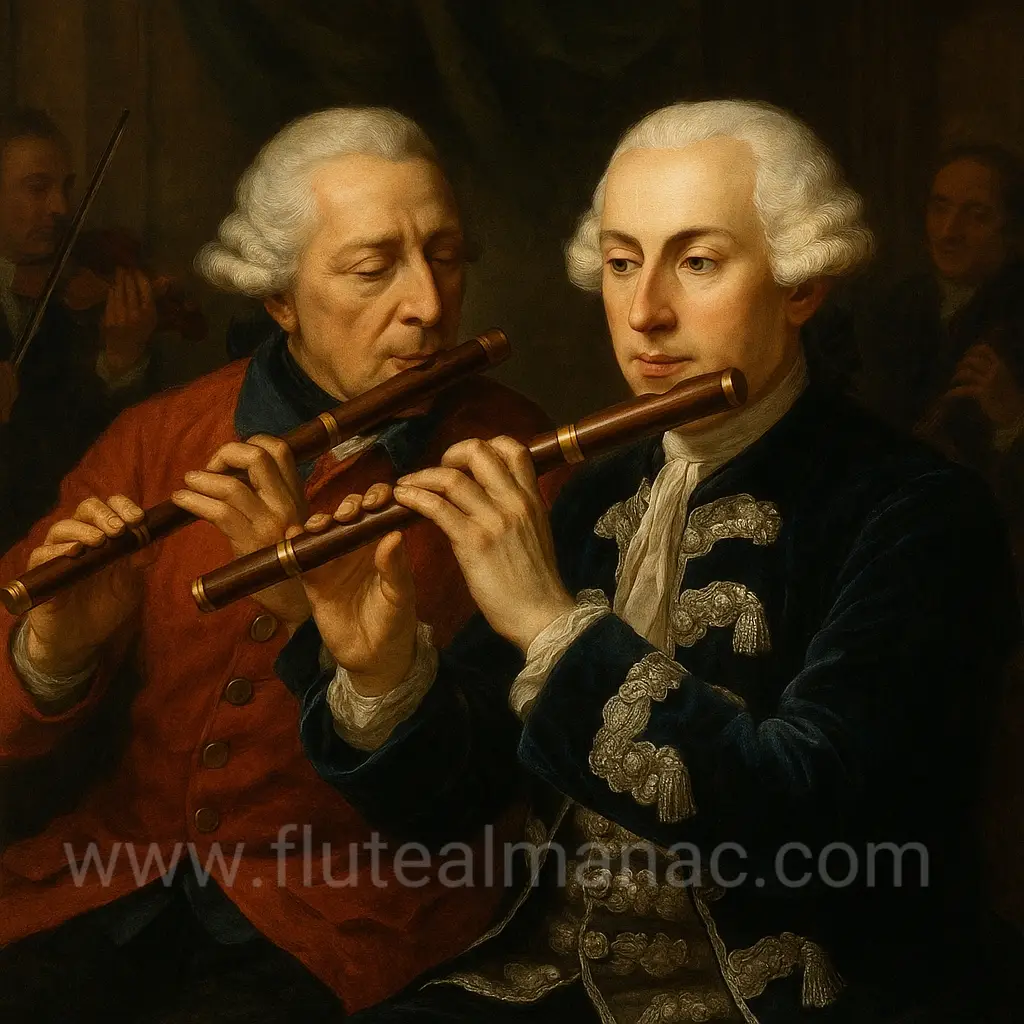
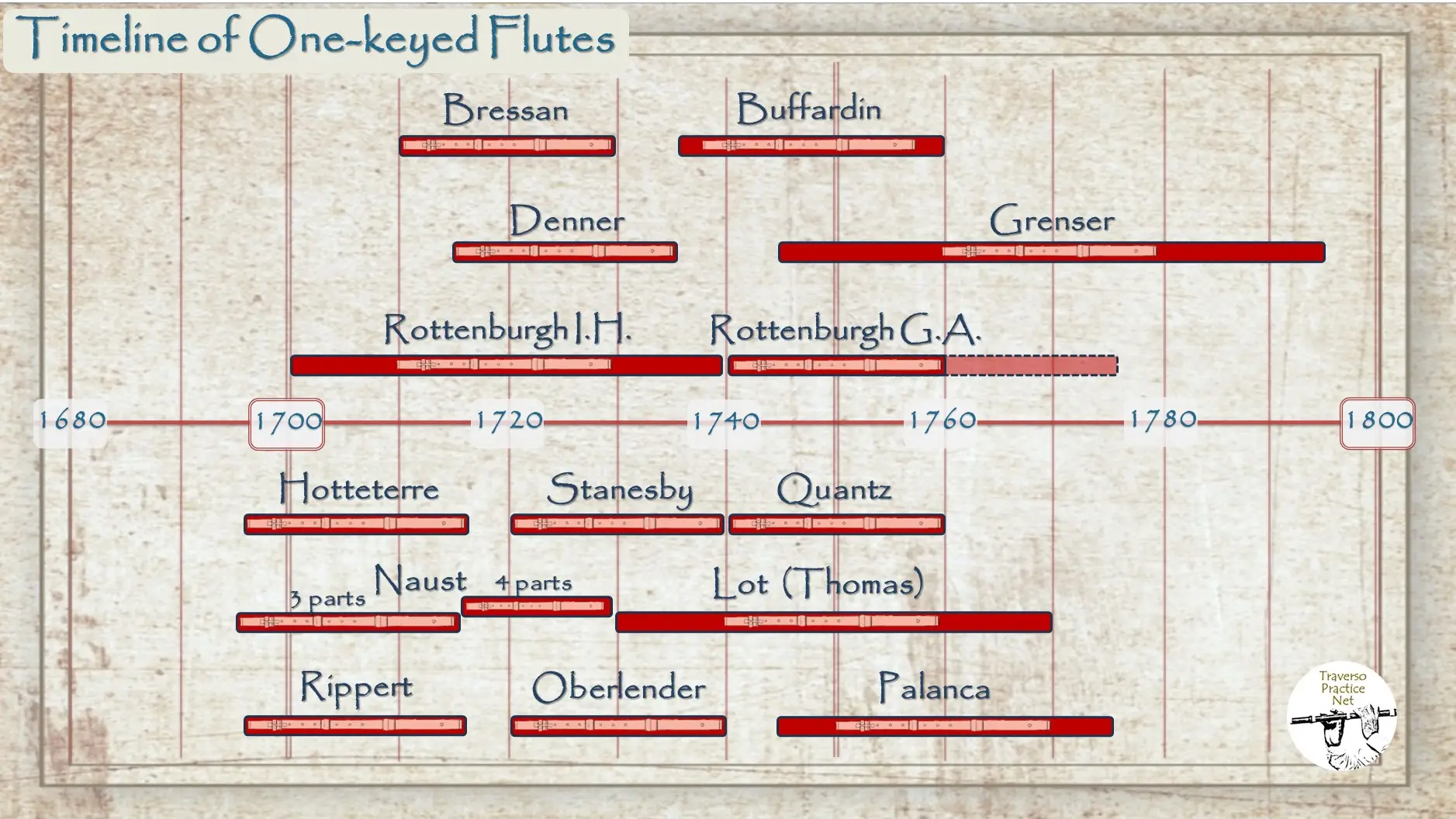
In 1741, Quantz accepted an invitation to join Frederick the Great’s court in Berlin and Potsdam as composer, flute teacher, and flute maker. His salary was unprecedented—2,000 thalers annually, plus bonuses for each new flute and composition. For over three decades, Quantz wrote hundreds of concertos and sonatas exclusively for the king, who played the flute daily in private chamber concerts at the Sanssouci Palace. These intimate concerts were legendary, with participants including Carl Philipp Emanuel Bach, the Benda brothers, and Graun.
The “Versuch”: Quantz’s Lasting Gift to Flutists
In 1752, Quantz published what would become one of the most significant treatises in the history of flute playing: Versuch einer Anweisung die Flöte traversiere zu spielen (On Playing the Transverse Flute). This monumental work, dedicated to Frederick the Great, offers invaluable insight into Baroque performance practice, ornamentation, articulation, musical taste, and pedagogy. It remains an essential resource for flutists and early music specialists to this day.
His influence was not limited to playing and composing – Quantz also designed and built flutes. He improved the mechanics of the instrument and often made flutes specifically tailored to the king’s preferences. Each new instrument was a work of art, crafted with care and designed to accommodate the king’s growing technical abilities.
Enlightenment Circles and the Montags-Club
Quantz was not only a musician but also an intellectual. He was a member of Berlin’s prestigious Montags-Club, a gathering place for Enlightenment thinkers such as Moses Mendelssohn, Gotthold Ephraim Lessing, and Friedrich Wilhelm Marpurg. It is believed that his association with this circle helped inspire the writing of his Versuch and deepened his philosophical understanding of music and aesthetics.
Final Years and Legacy
Quantz died on July 12, 1773, in Potsdam, after over 30 years of dedicated service to Frederick the Great. The king, who had so deeply valued his musical companion, had a monument erected in Quantz’s honor near the Nauener Tor.
Quantz’s legacy is monumental: over 300 flute concertos, numerous sonatas, chamber works, and a pedagogical treatise that defined an era. While much of his music remained unpublished during his lifetime (as it was written exclusively for the king), it has gradually found its way into the hands of modern performers and scholars.
Today, Quantz is recognized not only as a towering figure in the Baroque flute tradition but also as a key contributor to Enlightenment-era aesthetics and pedagogy. His music is rich with elegance, wit, and virtuosity – qualities that continue to inspire performers and audiences alike.
In Honor of His Legacy
On July 12, we commemorate the life and work of Johann Joachim Quantz — a man whose dedication to his craft, to his students, and to musical excellence helped define the Baroque flute and laid the foundation for generations of flutists. His music, treatise, and instrument innovations are a lasting testament to his vision.
Whether you revisit his concertos, explore his Versuch, or perform one of his elegant sonatas, this anniversary offers the perfect opportunity to reconnect with one of the flute’s greatest champions — and let his voice, through the flute, continue to sing.
Let his music fill your studio, concert hall, or home this week, and celebrate the legacy of the man who helped define the modern flutist.