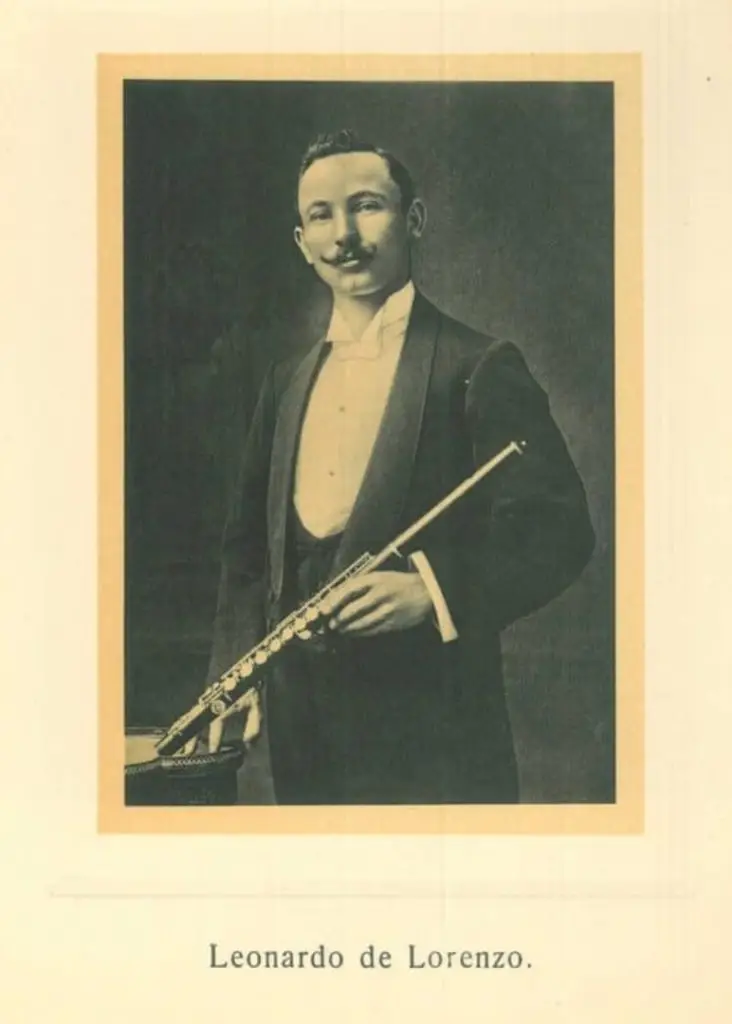
Today, we pause to honor one of the great pillars of the modern flute world – Leonardo De Lorenzo – who passed away on July 29, 1962, in Santa Barbara, California. More than six decades later, his influence as a performer, educator, composer, and historian continues to echo through concert halls, studios, and libraries across the globe.
A Flute Prodigy from the Mountains of Viggiano
Leonardo De Lorenzo was born on August 29, 1875, in Viggiano, a small town nestled in the mountains of southern Italy known for its rich tradition of traveling musicians. The son of a musical culture deeply rooted in folk traditions, De Lorenzo began playing the flute at the age of eight. He later studied at the prestigious Conservatorio San Pietro a Majella in Naples, where his talent quickly became evident.
But his journey would soon take him far beyond the conservatory walls. At just sixteen, he set sail for America, taking an unlikely job in a hotel in Cerulean, Kentucky. This early experience marked the beginning of a lifelong voyage – a literal and musical migration that would shape the course of his extraordinary career.
From the Military Band to Mahler’s Orchestra
After fulfilling military service in Alessandria, Italy, where he played in a military band, De Lorenzo launched an international performance career. He toured Italy, Germany, England, and South Africa, and at the age of 25 joined an orchestra in Cape Town – marking the beginning of his global musical journey.
Upon returning to the United States, De Lorenzo performed with the New York Philharmonic – including under Gustav Mahler – and substituted for Georges Barrèr. He also held principal positions in the Minneapolis, Los Angeles, and Rochester orchestras, solidifying his reputation on the American orchestral scene.
A Lifelong Partnership – On Stage and in Life
During his tenure with the Minneapolis Symphony Orchestra, De Lorenzo met pianist Maude Peterson, who not only accompanied him frequently in recitals but also became his life partner. Together, they formed a musical and personal bond that anchored much of his work during the most prolific years of his performing career.
In 1917, the Los Angeles Flute Club honored Leonardo De Lorenzo with a concert and named him an Honorary Member – one of the earliest distinctions of its kind. The event recognized his growing influence as a performer and his contributions to the American flute scene during a period when the instrument was still developing its identity in the United States.
The Pedagogue Behind Julius Baker


In 1923, De Lorenzo joined the faculty of the Eastman School of Music in Rochester, New York, where he taught for twelve years. During his tenure, he mentored a generation of flutists who would shape the future of American flute playing – most notably Julius Baker, who emerged as a towering figure in both performance and pedagogy. De Lorenzo’s teaching was marked by technical rigor, stylistic sensitivity, and a deep commitment to the historical context of the instrument. Many of his students went on to lead major orchestras and conservatories across the United States.
Compositions Rooted in Heritage
After retiring from the Eastman School of Music in 1935, De Lorenzo devoted himself to composition and scholarly research. He produced a vibrant catalog of flute music that often drew upon the folk traditions of his native southern Italy. Works like Saltarello (Op. 27) and Pizzica-Pizzica (Op. 37) pay tribute to the exuberant regional dances of his youth, while Suite mitologica (Op. 38) reflects his fascination with classical mythology.
His chamber output includes numerous works for flute ensembles, such as I tre virtuosi, Divertimento Flautistico (Sinfonietta, Op. 75), and Capriccio for four flutes (Op. 82). These compositions, often whimsical and virtuosic, continue to be enjoyed by flute choirs and advanced students around the world.
The Flute’s Historian
In 1951, De Lorenzo published what is still considered one of the most important books in flute literature: My Complete Story of the Flute. This landmark volume, born of meticulous research and a lifetime of experience, traces the development of the flute, its repertoire, and its performers across centuries. Today, it remains an essential reference for flutists, scholars, and students alike.
In 1953, De Lorenzo donated his extensive research archives to the University of Southern California, preserving his legacy for future generations. That same year, he was honored by the newly formed flute club in Milan, which invited him to serve as its symbolic godfather.
On his 80th birthday, August 29, 1955, the Los Angeles Flute Club celebrated with a concert dedicated entirely to his compositions.
A Lasting Legacy
Leonardo De Lorenzo passed away quietly at home in Santa Barbara on July 29, 1962 – just one month shy of his 87th birthday. But his voice, his vision, and his virtuosity live on. From the studios of Eastman to concert halls in Europe, from the pages of flute anthologies to competitions bearing his name, his imprint on the flute world is indelible.
From 1997 to 2013, the International Flute Competition “Leonardo De Lorenzo” was held in his hometown of Viggiano, celebrating his legacy and inspiring a new generation of flutists.
Why We Remember
On this 63rd anniversary of his passing, we invite flutists everywhere to revisit the life and legacy of Leonardo De Lorenzo – not just for his brilliant compositions or his role in shaping American flute pedagogy, but for his passionate belief that music, culture, and history are threads that must be woven together.
His story reminds us that the flute is not just an instrument – it is a journey.
🗓️ Leonardo De Lorenzo’s memorial date is listed in the Flute Almanac Calendar. You can easily sync our calendar with your favorite digital calendar to stay informed of upcoming flute anniversaries, premieres, and global events.