This article is part of a broader exploration of musical interpretation — where sound becomes structure, and structure becomes meaning.
→ Explore the full series: From Sound to Meaning
Flutists are naturally drawn to melody.
We follow the line.
We shape phrases.
We listen for beauty of tone.
This is not a weakness. It is a gift of the instrument itself.
But it is also where a subtle limitation begins.
The Natural Tendency of the Flute
Among all instruments, the flute invites a particular way of thinking.
Its sound is continuous.
It is created directly from breath.
It feels close to the human voice.
Because of this, flutists experience music as a flowing line.
And that flow feels complete.
But it is not.
Melody Is Only the Surface
A phrase can be beautifully shaped — and still remain unclear.
It can be expressive — and yet lack direction.
Why?
Because melody is only what we hear first.
It is not the full structure of the music.
Beneath every phrase, there are deeper relationships:
- tension and release
- rhythm and proportion
- points of arrival and departure
These create meaning.
The Illusion of Continuity
The flute’s greatest strength can also create its greatest illusion.
Because the sound is continuous, it can make music feel continuous.
But musical time is not continuous.
It is organized.
Even the most lyrical passage contains:
- internal punctuation
- shifts in weight
- structural direction
If these are not heard, the result is smooth playing — but not necessarily meaningful playing.
From Flow to Meaning
The difference between flowing playing and meaningful playing lies in awareness.




Flow is natural to the flute.
Meaning is constructed.
The shift happens when we stop asking:
“How should this sound?”
and begin to ask:
“What is happening here?”
When structure is understood, expression no longer needs to be imposed.
It begins to emerge.
Rethinking Expression
Much of flute pedagogy emphasizes expression through:
- vibrato
- dynamics
- shaping
These tools can be powerful.
But without structural understanding, they often become surface gestures.
Expression that is added can feel convincing.
Expression that emerges feels inevitable.
This idea of sound as something more than melody is explored further in my article on André Jolivet’s Cinq Incantations, where the flute emerges as a ritual voice rather than a purely lyrical instrument.
A Different Way of Listening
The most important change is not in playing — but in listening.
We begin to hear:
- relationships instead of isolated notes
- direction instead of movement
- intention instead of effect
Music becomes not just sound, but thought unfolding in time.
The Flute Reconsidered
When approached in this way, the flute reveals a deeper identity.
It is not only a melodic instrument.
It is a structural one.
It can shape time.
It can define space.
It can carry meaning — not only beauty.
But this requires a shift in how we think.
From Thought to Practice
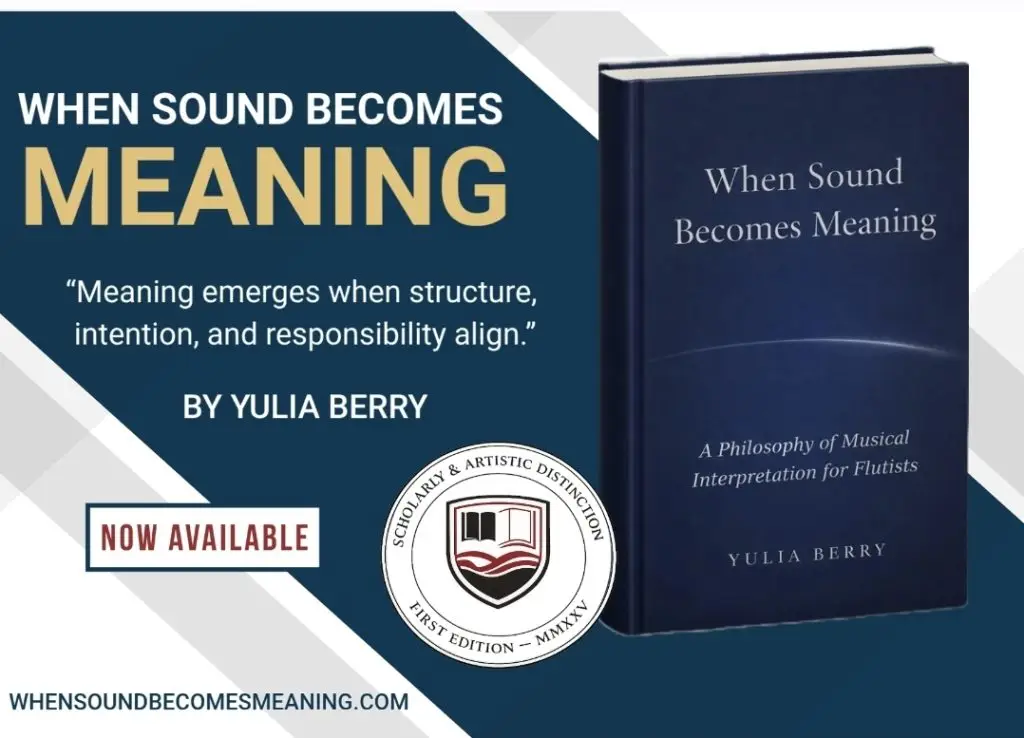
These ideas form the foundation of my recent book, When Sound Becomes Meaning: A Philosophy of Musical Interpretation for Flutists.
The book explores interpretation not as a set of techniques, but as a way of thinking — connecting sound, structure, perception, and artistic responsibility.
A Simple Question
Flutists naturally think in melody.
But meaning begins elsewhere.
And perhaps the most important question is:
Are we following the line —
or understanding it?
These ideas are explored more fully in my recent book: