Quote from Flute Almanac on November 26, 2025, 1:25 pm
A Forgotten Voice of the 18th Century
The name Niccolò (Nicolas) Dôthel is one that rarely surfaces today, yet in the late 18th century he was regarded alongside figures like Nardini and Campion as one of the finest musicians in Tuscany. Born in Luneville in 1721, Dôthel moved to Florence as a child with his father, a court oboist. He became a central figure in Florentine musical life for decades, playing in the Duke’s chapel, the grand ducal military band, and the Teatro della Pergola, where he took part in over fifty operas. Contemporary descriptions of his playing mention “agreeable and graceful melodies,” a fondness for triplets, an expressive use of breath, and a highly personal rubato. He was also astonishingly prolific: Prince Esterházy’s catalogue lists 95 flute works under his name, from concertos and sonatas to duets and trios, many published in Paris, London, and Amsterdam.
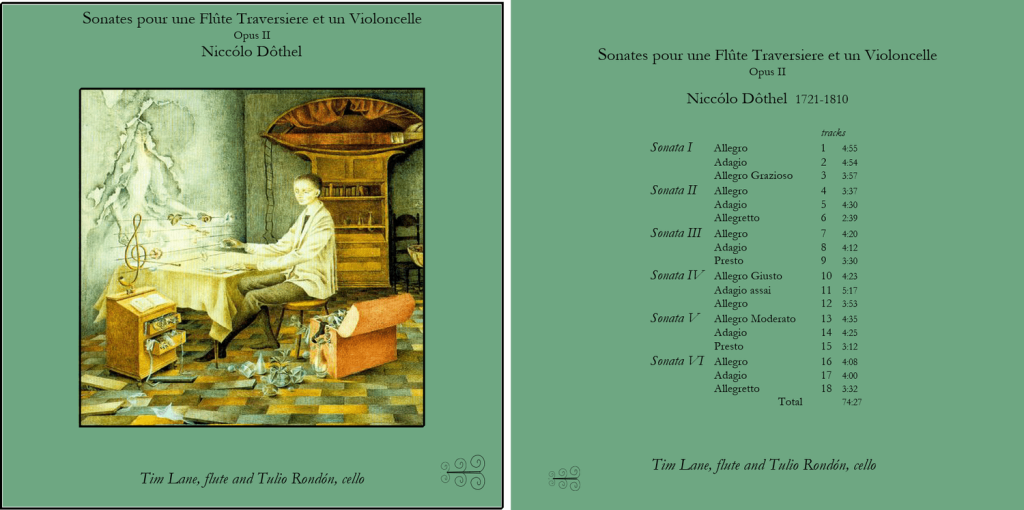
Yet despite such acclaim, Dôthel’s music has remained largely hidden from modern ears. That makes this new recording of his Sonates pour une Flûte Traversiere et un Violoncelle, Opus II by flutist Tim Lane and cellist Tulio Rondón not only a welcome rediscovery but also a revelation.
The Music: Intimacy and Balance
The six sonatas of Opus II are works of exquisite charm and sophistication. They belong to that fascinating period where the late Baroque melts into the early Classical style, balancing graceful melodies with elegant structures. What makes them particularly captivating is their scoring: instead of the more common flute–continuo partnership, Dôthel gives equal weight to the cello. Far from a mere bass-line instrument, the cello here dialogues with the flute, comments on its phrases, and at times takes the lead. This creates an intimate chamber conversation that feels fresh and alive even centuries later.
The movements alternate between sparkling Allegros, expressive Adagios, and playful dance-like sections. Listeners will notice the balance of operatic lyricism — unsurprising for a composer who played in Florence’s opera pit for decades—and instrumental virtuosity, particularly in the flute’s long, flowing lines interwoven with cello counterpoint. There are moments of striking beauty: the singing Adagio of Sonata I, the buoyant Presto of Sonata III, the noble Allegro Moderato that opens Sonata V or the stunning, deeply expressive Adagio from the same sonata, where the flute’s long-breathed lines unfold with poise, supported by the cello’s warm dialogue.
The Performers: Lane and Rondón
This repertoire demands not only technical command but also stylistic sensitivity, and Tim Lane and Tulio Rondón prove an ideal partnership. Lane’s flute sound is limpid and warm, with a natural vocal quality that brings Dôthel’s cantabile writing to life. His phrasing is flexible and deeply expressive, qualities that are no surprise to anyone familiar with his broader work as an author and pedagogue.
Lane is the author of two highly regarded resources for flutists: Interpretation & Expression: A Workbook for Musicians and Flute Playing and the Art of Doing Less, Parts I & II. These books reveal Lane’s remarkable ability to translate subtle aspects of expression, sound production, and efficient technique into clear, practical guidance for players. They are filled with insights that we at Flute Almanac have found invaluable — wisdom that most flutists could only gain through years of study with a truly exceptional teacher. The same qualities that make these volumes indispensable are audible here: Lane’s playing is at once thoughtful and spontaneous, expressive without exaggeration, and full of color and nuance.
Tulio Rondón, with his baroque-informed approach, shapes the cello part as more than accompaniment — his tone is rich, articulate, and conversational. Rondón’s background — spanning El Sistema in Venezuela, post-graduate baroque cello studies in The Hague, and a career as soloist and professor — gives him the stylistic authority to illuminate this music with authenticity.
Tim Lane, an experienced flutist with a deep curiosity for repertoire beyond the mainstream canon, clearly revels in bringing these forgotten sonatas back into the light.
The blend between the two is remarkable; their ensemble is so tight that one sometimes forgets these works were written more than two centuries ago.
Style and Musicianship
Lane and Rondón approach the sonatas with historically aware phrasing, yet without sacrificing expressive freedom. Ornamentation is tasteful, articulation is varied, and there is a sense of improvisatory freshness that keeps the listener engaged. The balance between flute and cello is never forced: at times the flute sings like a prima donna, while the cello provides a grounded yet witty counterpart; at other times, the cello steps forward in dialogue, reminding us that these sonatas are true duos, not flute solos with accompaniment.
The recorded sound is intimate and transparent, placing the listener right in the chamber. One hears not only the notes but the breath, bow strokes, and expressive detail that make chamber music so compelling.
Why This Album Matters
What makes this release particularly exciting is its contribution to expanding the known flute repertoire. In a world where recordings of Bach, Mozart, and Telemann abound, Dôthel offers something different: a glimpse into the flourishing of flute music in Italy during the second half of the 18th century. His sonatas reflect both his French origins and his Italian immersion, bridging two traditions with elegance and individuality. For performers, they offer a wealth of new possibilities; for listeners, they provide an hour of delightful, sophisticated, and deeply human music.
Conclusion
Tim Lane and Tulio Rondón have done the flute world a great service by championing Niccolò Dôthel’s Opus II Sonatas. Their performances are stylish, eloquent, and heartfelt, shining a bright light on a composer who deserves far greater recognition. This is more than a historical curiosity — it is music of lasting beauty, brought to life with conviction and artistry. Anyone who cares about the flute, about chamber music, or about rediscovering lost voices of the 18th century should not miss this recording.
Essential listening for flutists, cellists, and all lovers of elegant chamber music.
The name Niccolò (Nicolas) Dôthel is one that rarely surfaces today, yet in the late 18th century he was regarded alongside figures like Nardini and Campion as one of the finest musicians in Tuscany. Born in Luneville in 1721, Dôthel moved to Florence as a child with his father, a court oboist. He became a central figure in Florentine musical life for decades, playing in the Duke’s chapel, the grand ducal military band, and the Teatro della Pergola, where he took part in over fifty operas. Contemporary descriptions of his playing mention “agreeable and graceful melodies,” a fondness for triplets, an expressive use of breath, and a highly personal rubato. He was also astonishingly prolific: Prince Esterházy’s catalogue lists 95 flute works under his name, from concertos and sonatas to duets and trios, many published in Paris, London, and Amsterdam.
Yet despite such acclaim, Dôthel’s music has remained largely hidden from modern ears. That makes this new recording of his Sonates pour une Flûte Traversiere et un Violoncelle, Opus II by flutist Tim Lane and cellist Tulio Rondón not only a welcome rediscovery but also a revelation.
The Music: Intimacy and Balance
The six sonatas of Opus II are works of exquisite charm and sophistication. They belong to that fascinating period where the late Baroque melts into the early Classical style, balancing graceful melodies with elegant structures. What makes them particularly captivating is their scoring: instead of the more common flute–continuo partnership, Dôthel gives equal weight to the cello. Far from a mere bass-line instrument, the cello here dialogues with the flute, comments on its phrases, and at times takes the lead. This creates an intimate chamber conversation that feels fresh and alive even centuries later.
The movements alternate between sparkling Allegros, expressive Adagios, and playful dance-like sections. Listeners will notice the balance of operatic lyricism — unsurprising for a composer who played in Florence’s opera pit for decades—and instrumental virtuosity, particularly in the flute’s long, flowing lines interwoven with cello counterpoint. There are moments of striking beauty: the singing Adagio of Sonata I, the buoyant Presto of Sonata III, the noble Allegro Moderato that opens Sonata V or the stunning, deeply expressive Adagio from the same sonata, where the flute’s long-breathed lines unfold with poise, supported by the cello’s warm dialogue.
The Performers: Lane and Rondón
This repertoire demands not only technical command but also stylistic sensitivity, and Tim Lane and Tulio Rondón prove an ideal partnership. Lane’s flute sound is limpid and warm, with a natural vocal quality that brings Dôthel’s cantabile writing to life. His phrasing is flexible and deeply expressive, qualities that are no surprise to anyone familiar with his broader work as an author and pedagogue.
Lane is the author of two highly regarded resources for flutists: Interpretation & Expression: A Workbook for Musicians and Flute Playing and the Art of Doing Less, Parts I & II. These books reveal Lane’s remarkable ability to translate subtle aspects of expression, sound production, and efficient technique into clear, practical guidance for players. They are filled with insights that we at Flute Almanac have found invaluable — wisdom that most flutists could only gain through years of study with a truly exceptional teacher. The same qualities that make these volumes indispensable are audible here: Lane’s playing is at once thoughtful and spontaneous, expressive without exaggeration, and full of color and nuance.
Tulio Rondón, with his baroque-informed approach, shapes the cello part as more than accompaniment — his tone is rich, articulate, and conversational. Rondón’s background — spanning El Sistema in Venezuela, post-graduate baroque cello studies in The Hague, and a career as soloist and professor — gives him the stylistic authority to illuminate this music with authenticity.
Tim Lane, an experienced flutist with a deep curiosity for repertoire beyond the mainstream canon, clearly revels in bringing these forgotten sonatas back into the light.
The blend between the two is remarkable; their ensemble is so tight that one sometimes forgets these works were written more than two centuries ago.
Style and Musicianship
Lane and Rondón approach the sonatas with historically aware phrasing, yet without sacrificing expressive freedom. Ornamentation is tasteful, articulation is varied, and there is a sense of improvisatory freshness that keeps the listener engaged. The balance between flute and cello is never forced: at times the flute sings like a prima donna, while the cello provides a grounded yet witty counterpart; at other times, the cello steps forward in dialogue, reminding us that these sonatas are true duos, not flute solos with accompaniment.
The recorded sound is intimate and transparent, placing the listener right in the chamber. One hears not only the notes but the breath, bow strokes, and expressive detail that make chamber music so compelling.
Why This Album Matters
What makes this release particularly exciting is its contribution to expanding the known flute repertoire. In a world where recordings of Bach, Mozart, and Telemann abound, Dôthel offers something different: a glimpse into the flourishing of flute music in Italy during the second half of the 18th century. His sonatas reflect both his French origins and his Italian immersion, bridging two traditions with elegance and individuality. For performers, they offer a wealth of new possibilities; for listeners, they provide an hour of delightful, sophisticated, and deeply human music.
Conclusion
Tim Lane and Tulio Rondón have done the flute world a great service by championing Niccolò Dôthel’s Opus II Sonatas. Their performances are stylish, eloquent, and heartfelt, shining a bright light on a composer who deserves far greater recognition. This is more than a historical curiosity — it is music of lasting beauty, brought to life with conviction and artistry. Anyone who cares about the flute, about chamber music, or about rediscovering lost voices of the 18th century should not miss this recording.
Essential listening for flutists, cellists, and all lovers of elegant chamber music.
This is your space to connect, share, and explore the world of flute with a global community of flutists, educators, and enthusiasts.
Whether you’re here to discuss the latest flute repertoire, share tips on technique, explore the flute’s rich history, or simply connect with fellow musicians, this forum is designed to foster engaging and meaningful conversations.
At Flute Almanac, we believe in the power of community and the exchange of knowledge. Our forum is organized into various categories that cater to different aspects of flute playing and learning, ensuring that you can easily find topics that interest you. Whether you’re a beginner seeking advice, a professional looking to share your expertise, or a curious learner wanting to delve deeper into flute culture and history, you’ll find a welcoming space here.
Join the conversation, ask questions, share your experiences, and help build a vibrant, supportive community where every flutist, regardless of their level, can find value and inspiration.
We’re excited to have you here and look forward to your contributions!