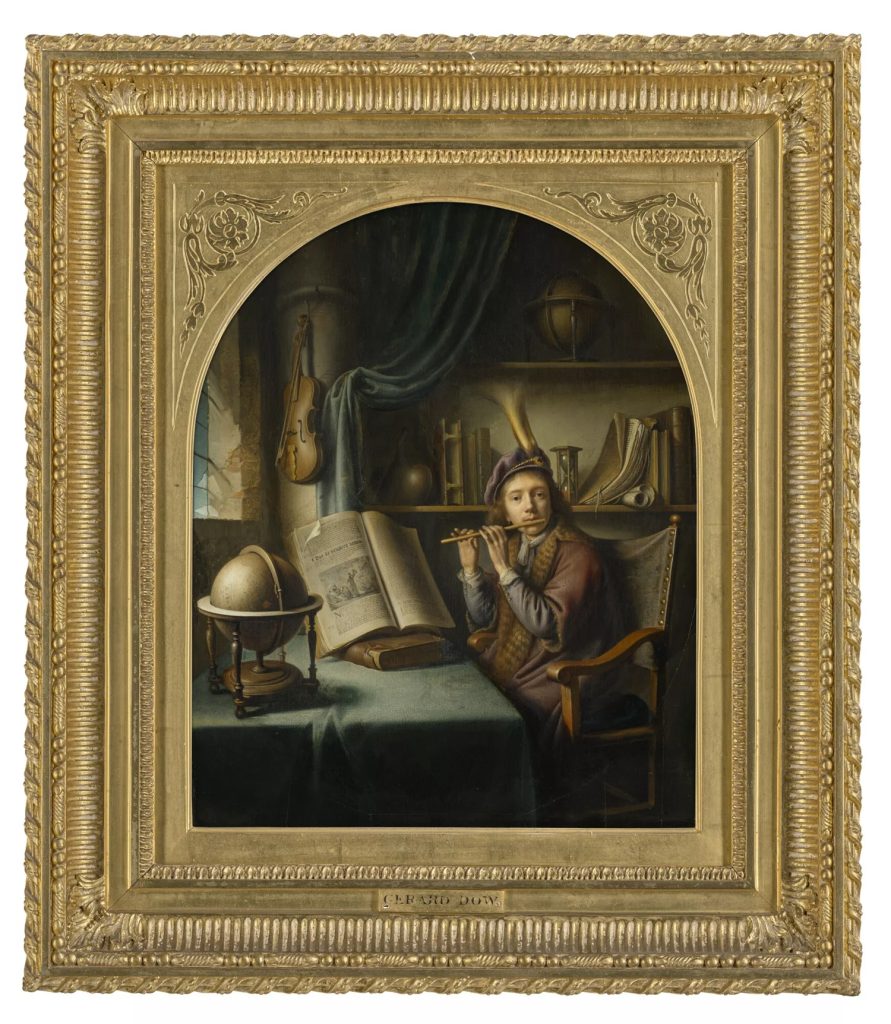
Trained in the studio of Rembrandt at just fifteen years old, Gerrit Dou went on to become the supreme master of Dutch fijnschilder painting. This legacy was powerfully reaffirmed on 2 December 2025, when Dou’s The Flute Player sold for £3,832,000 at Christie’s in London.
Absent from the market for over 125 years, the painting re-emerged not only as a major Old Master rediscovery, but also as a rare and early visual testament to the cultural status of the flute in the seventeenth century.
A Rediscovered Masterpiece
For more than a century, The Flute Player remained quietly preserved in an English country house collection, passing by descent and largely absent from public discourse. Such long periods of seclusion are uncommon for works of this calibre. Most paintings by Dou have circulated among major European collections, appeared in exhibitions, and been the subject of sustained scholarly attention. The reappearance of The Flute Player therefore carried a particular sense of anticipation—one that was fully reflected in the strong bidding it attracted.
Its sale confirms not only the enduring appeal of Dou’s art, but also the market’s appetite for works that combine rarity, pristine provenance, and clear art-historical importance.
The Earliest Musician in Dou’s Oeuvre
Among the many reasons this painting holds exceptional interest is its status as Dou’s earliest known depiction of a musician. The young flutist appears framed within a shallow niche, surrounded by objects associated with learning and worldly accomplishment: books, globes, musical instruments, and an hourglass. Together, they situate the work firmly within the Dutch vanitas tradition — a visual language in which beauty and knowledge are inseparable from the awareness of time’s passing. Music plays a central symbolic role. Sound exists only in the moment of performance, vanishing as soon as it is created. In the seventeenth-century Dutch Republic, this idea resonated deeply with a society that was prosperous, educated, and yet morally reflective about the transient nature of earthly success. The flute, refined and intimate, was an ideal instrument through which to express this tension.
Precision, Patience, and the Fijnschilder Ideal
Dou’s technical approach was legendary even in his own lifetime. Unlike many of his contemporaries, he worked slowly and meticulously, producing a relatively small number of paintings. Contemporary sources describe his insistence on immaculate working conditions, his use of hand supports to steady the brush, and his ability to render surfaces with astonishing clarity.
In The Flute Player, this precision is already fully developed. Fabrics appear soft and tactile, metal gleams with restrained brilliance, and glass conveys both transparency and fragility. There are no visible brushstrokes—only a luminous, enamel-like surface that rewards prolonged, close viewing. This was the essence of the fijnschilder tradition, and Dou stood at its pinnacle.
One of the most striking features of The Flute Player is the musician’s gaze. Rather than remaining absorbed in performance, he looks directly outward, engaging the viewer. This quiet psychological connection is characteristic of Dou’s work and sets him apart from many genre painters of his time.
The effect is subtle but powerful. The viewer is not merely observing a scene, but participating in it—drawn into a silent exchange that bridges four centuries. This sense of intimacy helps explain why Dou’s paintings were so highly prized by elite collectors during his lifetime and beyond.
From Rembrandt’s Pupil to Independent Master
Dou entered Rembrandt’s studio in Leiden in 1628, becoming one of his earliest students. While Rembrandt moved toward expressive brushwork and dramatic contrasts, Dou pursued a different ideal — one of control, refinement, and surface perfection. The divergence of their paths highlights the richness of Dutch Golden Age painting, in which radically different artistic solutions could coexist and thrive.
By the time The Flute Player was painted, Dou had already established a distinct artistic identity. The painting stands at a formative moment in his career, combining technical bravura with intellectual depth and symbolic clarity.
A Market Result with Lasting Meaning
The £3.83 million result places The Flute Player firmly among the most significant Old Master sales of recent years. In a selective market, where quality and significance prevail, Dou’s painting met every criterion: rarity, impeccable provenance, exceptional condition, and a subject of enduring cultural relevance.
For the global flute community, the painting’s reappearance and successful sale carry an added layer of meaning. The Flute Player is not merely a genre scene, but a visual document that reflects the flute’s association with intellect, refinement, and the fleeting nature of beauty at a pivotal moment in European cultural history.
Its journey — from Rembrandt’s studio, to centuries of quiet preservation, and finally to the auction block — underscores the enduring power of images that unite music, philosophy, and extraordinary craftsmanship.
Trained in the studio of Rembrandt at just fifteen years old, Gerrit Dou went on to become the supreme master of Dutch fijnschilder painting. This legacy was powerfully reaffirmed on 2 December 2025, when Dou’s The Flute Player sold for £3,832,000 at Christie’s in London.
Absent from the market for over 125 years, the painting re-emerged not only as a major Old Master rediscovery, but also as a rare and early visual testament to the cultural status of the flute in the seventeenth century.
A Rediscovered Masterpiece
For more than a century, The Flute Player remained quietly preserved in an English country house collection, passing by descent and largely absent from public discourse. Such long periods of seclusion are uncommon for works of this calibre. Most paintings by Dou have circulated among major European collections, appeared in exhibitions, and been the subject of sustained scholarly attention. The reappearance of The Flute Player therefore carried a particular sense of anticipation—one that was fully reflected in the strong bidding it attracted.
Its sale confirms not only the enduring appeal of Dou’s art, but also the market’s appetite for works that combine rarity, pristine provenance, and clear art-historical importance.
The Earliest Musician in Dou’s Oeuvre
Among the many reasons this painting holds exceptional interest is its status as Dou’s earliest known depiction of a musician. The young flutist appears framed within a shallow niche, surrounded by objects associated with learning and worldly accomplishment: books, globes, musical instruments, and an hourglass. Together, they situate the work firmly within the Dutch vanitas tradition — a visual language in which beauty and knowledge are inseparable from the awareness of time’s passing. Music plays a central symbolic role. Sound exists only in the moment of performance, vanishing as soon as it is created. In the seventeenth-century Dutch Republic, this idea resonated deeply with a society that was prosperous, educated, and yet morally reflective about the transient nature of earthly success. The flute, refined and intimate, was an ideal instrument through which to express this tension.
Precision, Patience, and the Fijnschilder Ideal
Dou’s technical approach was legendary even in his own lifetime. Unlike many of his contemporaries, he worked slowly and meticulously, producing a relatively small number of paintings. Contemporary sources describe his insistence on immaculate working conditions, his use of hand supports to steady the brush, and his ability to render surfaces with astonishing clarity.
In The Flute Player, this precision is already fully developed. Fabrics appear soft and tactile, metal gleams with restrained brilliance, and glass conveys both transparency and fragility. There are no visible brushstrokes—only a luminous, enamel-like surface that rewards prolonged, close viewing. This was the essence of the fijnschilder tradition, and Dou stood at its pinnacle.
One of the most striking features of The Flute Player is the musician’s gaze. Rather than remaining absorbed in performance, he looks directly outward, engaging the viewer. This quiet psychological connection is characteristic of Dou’s work and sets him apart from many genre painters of his time.
The effect is subtle but powerful. The viewer is not merely observing a scene, but participating in it—drawn into a silent exchange that bridges four centuries. This sense of intimacy helps explain why Dou’s paintings were so highly prized by elite collectors during his lifetime and beyond.
From Rembrandt’s Pupil to Independent Master
Dou entered Rembrandt’s studio in Leiden in 1628, becoming one of his earliest students. While Rembrandt moved toward expressive brushwork and dramatic contrasts, Dou pursued a different ideal — one of control, refinement, and surface perfection. The divergence of their paths highlights the richness of Dutch Golden Age painting, in which radically different artistic solutions could coexist and thrive.
By the time The Flute Player was painted, Dou had already established a distinct artistic identity. The painting stands at a formative moment in his career, combining technical bravura with intellectual depth and symbolic clarity.
A Market Result with Lasting Meaning
The £3.83 million result places The Flute Player firmly among the most significant Old Master sales of recent years. In a selective market, where quality and significance prevail, Dou’s painting met every criterion: rarity, impeccable provenance, exceptional condition, and a subject of enduring cultural relevance.
For the global flute community, the painting’s reappearance and successful sale carry an added layer of meaning. The Flute Player is not merely a genre scene, but a visual document that reflects the flute’s association with intellect, refinement, and the fleeting nature of beauty at a pivotal moment in European cultural history.
Its journey — from Rembrandt’s studio, to centuries of quiet preservation, and finally to the auction block — underscores the enduring power of images that unite music, philosophy, and extraordinary craftsmanship.
Welcome to the Flute Almanac Forum!
This is your space to connect, share, and explore the world of flute with a global community of flutists, educators, and enthusiasts.
Whether you’re here to discuss the latest flute repertoire, share tips on technique, explore the flute’s rich history, or simply connect with fellow musicians, this forum is designed to foster engaging and meaningful conversations.
At Flute Almanac, we believe in the power of community and the exchange of knowledge. Our forum is organized into various categories that cater to different aspects of flute playing and learning, ensuring that you can easily find topics that interest you. Whether you’re a beginner seeking advice, a professional looking to share your expertise, or a curious learner wanting to delve deeper into flute culture and history, you’ll find a welcoming space here.
Join the conversation, ask questions, share your experiences, and help build a vibrant, supportive community where every flutist, regardless of their level, can find value and inspiration.
We’re excited to have you here and look forward to your contributions!