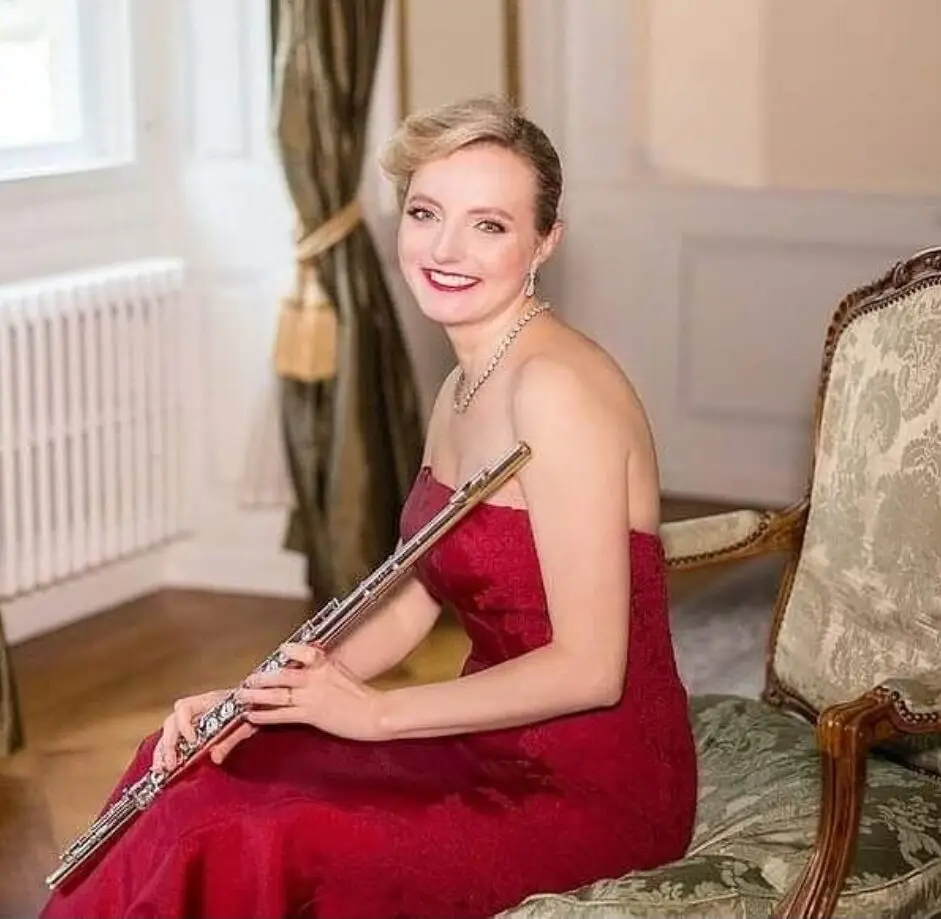
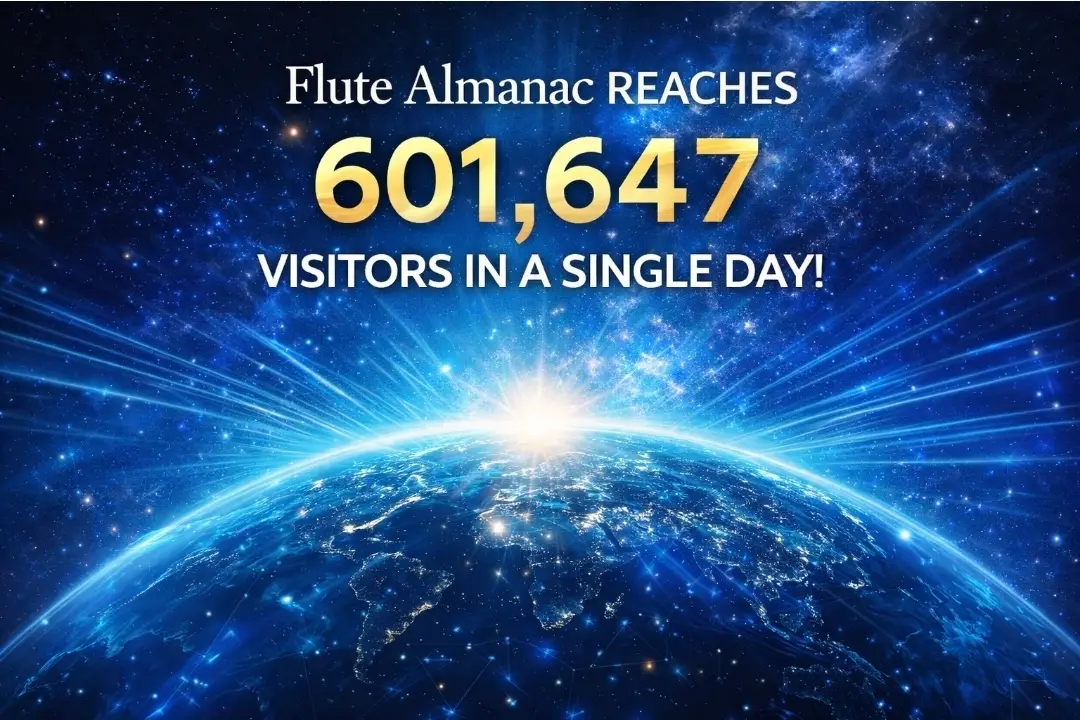
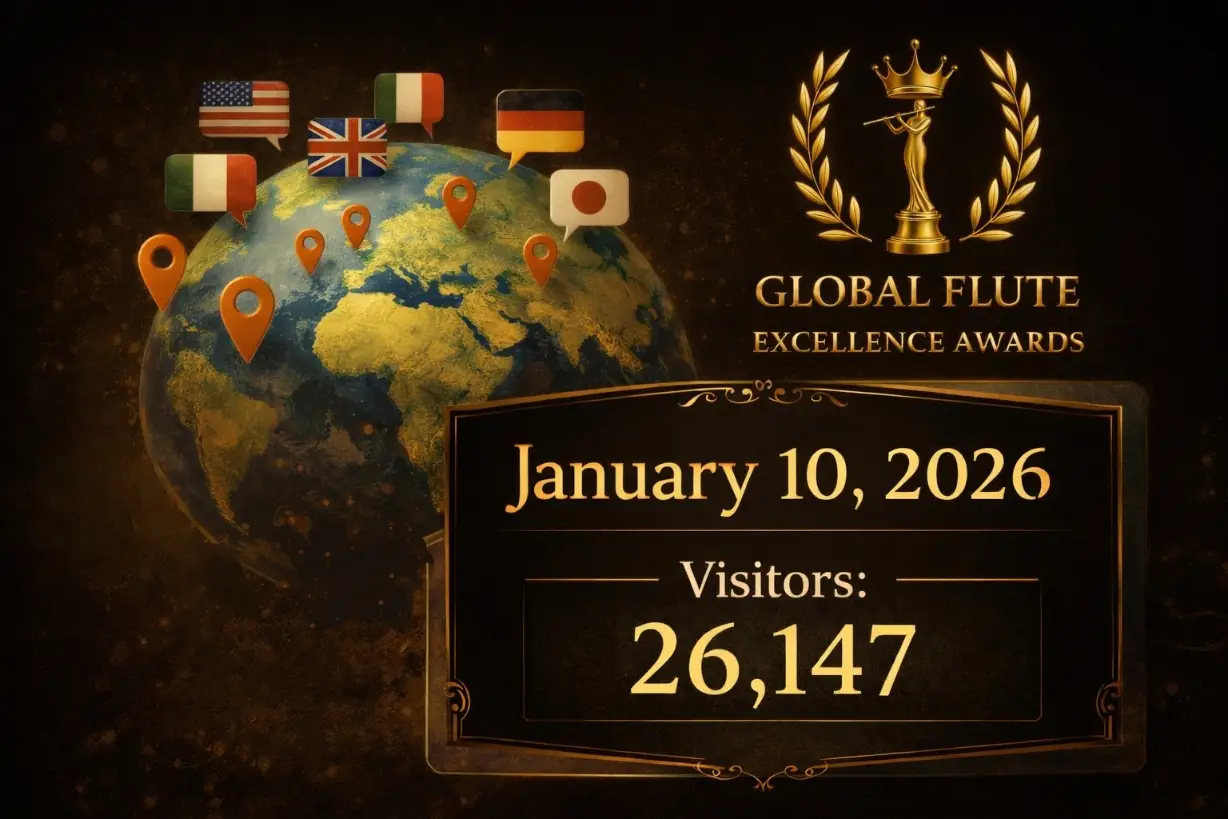
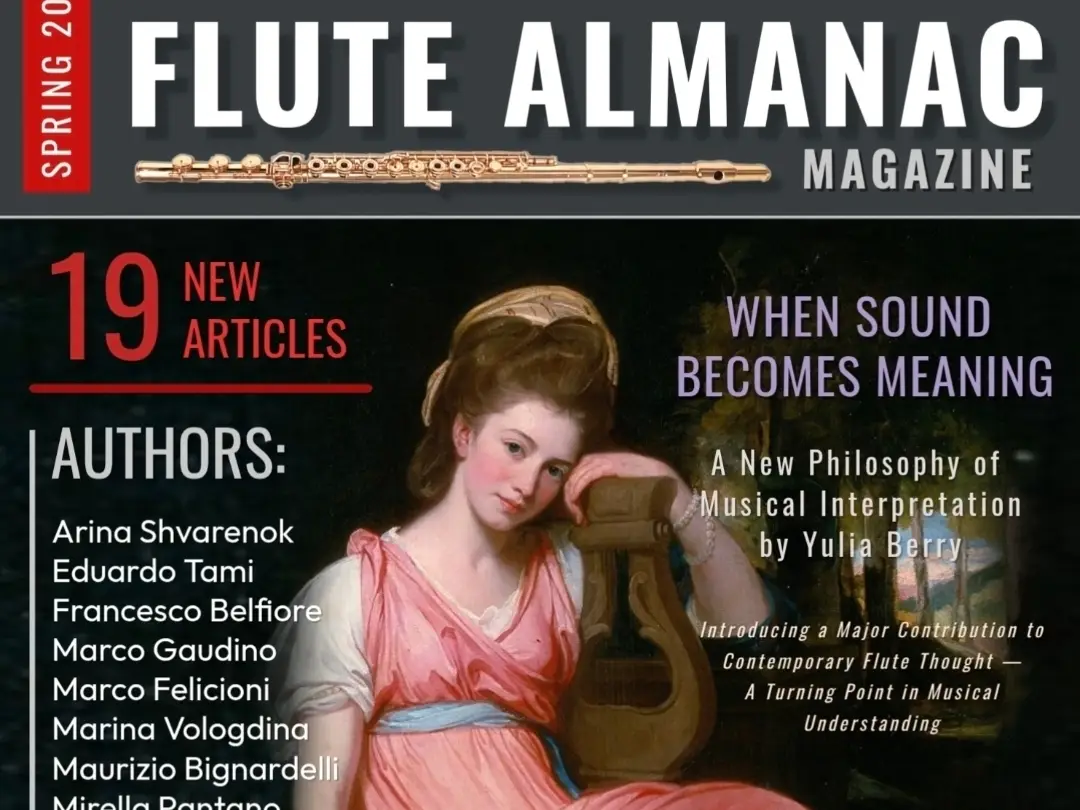
Today I am speaking with Yulia Berry — flutist, educator, and visionary founder of Flute Almanac, the leading global flute magazine. In less than a year, Flute Almanac has been recognized as the Best Flute Magazine by Google AI and as the Best News Portal by Microsoft Copilot. Yulia is also the creator of the groundbreaking Global Flute Excellence Awards — the first international recognition of its kind — and the brand-new Global Flute Almanac Directory, a prestigious platform that connects flutists, institutions, makers, and organizations around the world. Both are part of the expanding Flute Almanac Universal Platform.
Through these projects, Yulia has built what many call a “global ecosystem” for the flute community — uniting education, recognition, and connection on a scale never seen before.

Sofia: Yulia, so much has happened since our interview a few years ago about The Babel Flute. Today, we’re reconnecting to talk about how your journey has evolved and the new platforms you’ve created for the global flute community.
How did your personal journey with the flute begin, and what drew you so deeply to this instrument?
My journey with the flute began in childhood in Saint Petersburg. The first time I heard its voice — delicate yet powerful — I felt it could express emotions I didn’t yet have words for. From that moment, the flute became my lifelong language for beauty, storytelling, and connection.
That encounter set the course of my life. I entered the Mravinsky State Music School, continued at the Mussorgsky State College of Music, graduating cum laude, and later earned both my Master’s and Doctor of Musical Arts degrees at the St. Petersburg State Conservatory named after Rimsky-Korsakov. Those years shaped me not only as a professional but as a person — the flute became my language for storytelling, beauty, and connection. That spark has never faded; it still guides me as a performer, teacher, and creator of global flute projects.
Were there decisive moments or mentors who set you on the path not only as a performer, but also as someone who would later build global platforms for flutists?
It wasn’t one mentor, but rather curiosity and a constant drive to learn. Alongside my musical career, I taught myself web development in 2006 and spent nearly two decades building websites, e-learning platforms, and mobile apps. At the same time, I became aware of how fragmented the flute world was — full of talent and ideas, yet scattered and disconnected.
In 2013, I created the All About Flute app, which delivered instant pop-up notifications to flutists worldwide. It was much ahead of its time, but it planted a seed: the flute community could be united by technology. That realization shaped everything that followed.
Many musicians focus solely on performance and teaching. Was there a turning point when you decided to create something larger for the global flute world?
Yes. Performing and teaching were fulfilling, but I often felt that brilliance in our field remained confined within local borders. I wanted to build spaces where knowledge, artistry, and inspiration could circulate globally — where a flutist in one corner of the world could feel connected to another thousands of miles away.
The turning point came when I understood how powerful technology could be in making that possible. Early experiments with e-learning projects and the All About Flute app convinced me that borders could dissolve in real time. That conviction eventually led to larger initiatives: The Babel Flute, the record-setting Global Flute Convention, and now Flute Almanac, with its Awards and Directory.
Flute Almanac
When you launched Flute Almanac, did you imagine it would grow into such a popular global platform? What was your original vision?
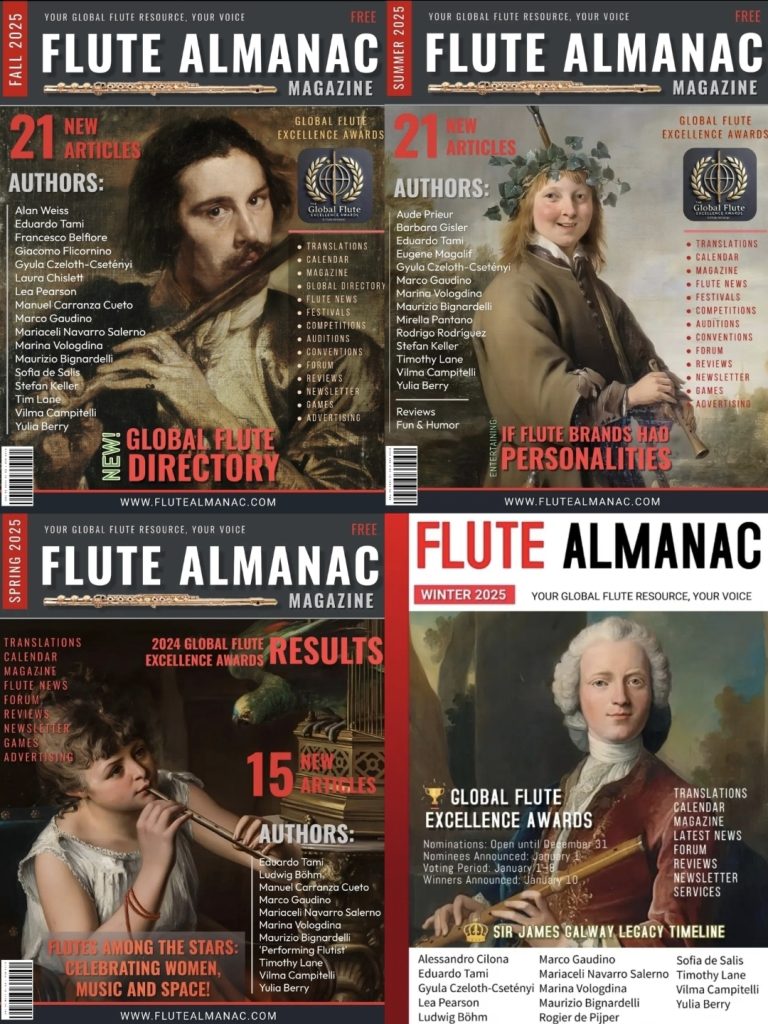
From the start, I envisioned not just a magazine but a living ecosystem — with articles, history, news, a global events calendar, educational resources, global directory and even interactive projects like the upcoming virtual museum. The goal was to unite the flute world and make knowledge and inspiration available to everyone.
Seeing flutists from so many countries embrace Flute Almanac confirmed that the need for a global, multilingual platform was very real.
The magazine covers such a wide range — from flute history and pedagogy to new music, competitions, and even mythology. How do you decide on the balance of content?
Because the flute is more than an instrument — it’s a bridge between history, culture, and innovation. Each edition balances pedagogy to support students and teachers, history to preserve heritage, current news to keep us connected, and creative topics to inspire imagination.
And since the magazine is instantly translatable, contributions come from every corner of the world. That diversity naturally shapes the balance, making Flute Almanac a shared voice of the global community.
Flute Almanac is instantly translatable into any language. How important was multilingual accessibility to you, and how has it helped connect the global flute community?
It was central to my vision. For too long, language barriers kept knowledge within borders. I wanted to remove that completely.
Now, a flutist in Japan can read the same article as a colleague in Brazil, or a student in Egypt can learn from the same resources as a professor in Germany. This feature doesn’t just make the magazine accessible — it makes it universal.
What challenges have you faced running such a large publication while also performing and teaching?
The greatest challenge is time. Running Flute Almanac means editing, copywriting, web development, coordinating across time zones, and constant updates — on top of teaching and performing.
It’s demanding, but each area feeds the others: teaching shows me what young flutists need, performing keeps me artistically alive, and publishing allows me to share globally.
Can you share a moment when reader feedback reminded you why this work is so important?
One young flutist in South America wrote that Flute Almanac had become her “window to the flute world,” since she had no access to teachers or events. A professor in Asia shared that he uses translated articles in his classes.
Messages like these remind me the magazine isn’t just about publishing — it’s about connection, encouragement, and belonging.
Many consider Flute Almanac a cultural archive. Do you see it that way, and how do you hope future generations will view it?
Yes. From the very beginning, I envisioned Flute Almanac as more than just a magazine — almost like a modern encyclopedia or cultural archive of the flute. Each article captures not only the artistry of music-making today, but also the values, ideas, and innovations shaping our community.
I hope future generations will see Flute Almanac as a treasure trove of knowledge — a living record that proves how creative, diverse, and interconnected the flute world became in the 21st century.
Global Flute Excellence Awards
These awards are the first of their kind — not a competition, but recognition. Why was it important to create them?
Competitions are valuable, but they recognize only a handful of winners and often create division. I wanted something different: recognition without rivalry.
Excellence in the flute world takes many forms — performers, teachers, composers, makers, ensembles, advocates. The Awards honor that diversity and affirm that there are many meaningful paths to greatness.
The Global Flute Excellence Awards are not an alternative to competitions — they are something entirely new, because nothing like this has ever existed before.
How do you select honorees? What qualities do you look for?
Nominations are open to the global community — anyone can submit, as long as they provide supporting materials. An international jury from nearly 20 countries reviews each case.
We look beyond artistry to dedication, vision, and impact. A teacher who transforms lives, a maker who advances the instrument, or an advocate who builds community — all of these represent excellence.
The Awards connect directly to Flute Almanac and the new Directory. How do these three projects interlink?
They are three branches of one vision. Flute Almanac documents, educates, and reflects the ongoing story of the flute world. The Global Flute Excellence Awards celebrate achievement by recognizing the people, institutions, and innovations that shape that story. The Global Directory preserves those names, giving them a permanent home in a prestigious global resource where future generations can discover them.
Together, they form a living ecosystem: Flute Almanac provides knowledge and context, the Awards offer recognition and inspiration, and the Directory ensures visibility and continuity. In this way, they don’t just coexist — they reinforce one another, creating a universal platform that both honors today and safeguards our legacy for tomorrow.
Which winners or nominees have inspired you most?
One that deeply moved me was Anton Kushnir, who founded the Ukrainian Flute Society during a time of military conflict. His courage and leadership showed how music can unite and give hope even in the darkest circumstances.
Have you seen the Awards impact people’s careers?
We’ve had only one edition so far, but the support was overwhelming. It drew great attention to nominees and winners, raising their visibility. I’m certain it has already had a positive impact and will continue to grow in influence.
Do you believe recognition, rather than rivalry, can change the culture of the flute world?


Absolutely — it’s the only way forward. Rivalry pushes individuals, but recognition uplifts an entire community.
When we honor contributions across performance, teaching, making, composing, and advocacy, we show that excellence has many faces. Recognition fosters collaboration and inspiration, while rivalry too often divides.
Global Flute Almanac Directory
What inspired you to create this directory — and why now?
I wanted a central, prestigious place where flutists, institutions, makers, and organizations could all be visible side by side.
The timing was right — the community was already coming together through Flute Almanac and the Awards. The Directory is the natural next step: a lasting platform that unites, connects, and preserves.
How did you choose the categories, and what expansions do you see?
The categories were carefully designed to reflect every dimension of the flute world — from flutists, ensembles, institutions, and competitions to retailers, publishers, makers, researchers, and festivals of every kind. My goal was to create a framework where no one is left out, where both the visible performers and the behind-the-scenes contributors have a place.
At this point, the structure is already very comprehensive. I don’t anticipate needing to invent new categories, because the essential ones are all established. Still, I remain open to adding more if the flute community itself evolves in unexpected ways. The priority is to keep the Directory inclusive, accurate, and lasting.
Why create the Global Flute Almanac Directory, and what sets it apart?
There has never been a comprehensive, international directory for the flute community. Existing listings are usually local, limited in scope, or quickly become outdated. I wanted to build something entirely new: a curated, multilingual, and truly global resource that brings together flutists, ensembles, institutions, makers, publishers, retailers, festivals, competitions, and more — all in one place.
The Directory is not just a list of contacts. It provides recognition, visibility, and context within the larger story of the flute, directly linked to Flute Almanac and the Global Flute Excellence Awards. It’s designed to be both prestigious and practical — a lasting reference for today’s community and a historical record for future generations.
How will it help underrepresented flutists and organizations?
Because it’s multilingual and searchable by specialty and geography, it gives visibility to voices that might otherwise remain unheard — whether a small-town festival, a young teacher, or a maker in a niche tradition.
Also, we don’t turn anyone away. If someone can’t afford a paid plan, they can apply for a free listing.
How important were accessibility and fairness in its design?
Essential. That’s why we offer both free and paid options, and why Awards winners and Flute Almanac authors are automatically included.
The goal is not just a commercial service, but a cultural resource that reflects the true richness of our field.
Beyond being a directory, it seems to act as a prestigious showcase. How do you think this will influence careers and collaborations?
That’s exactly the idea. Inclusion in the Directory signals professionalism and connection to a respected global network. It immediately gives flutists and organizations credibility — recognition that they are part of an international standard of excellence.
For individual flutists, this means visibility far beyond their local circle. Students, teachers, and professionals can be discovered by festivals, ensembles, or collaborators in other countries. Makers, publishers, and institutions gain access to audiences they might never reach otherwise. The multilingual design ensures that geography and language are no longer barriers to being seen.
It also creates opportunities that flutists simply don’t have right now:
Global exposure in a curated, prestigious setting, rather than being lost in social media noise.
Cross-continental collaborations — composers finding performers, performers connecting with festivals, teachers linking with students worldwide.
Historical recognition — a lasting record of their contributions in a resource that future generations will consult.
Contextual prestige — being listed not just as a name and contact, but alongside awards, magazine features, and cultural milestones that give deeper meaning to their work.
In this way, the Directory doesn’t just document the flute world — it helps shape it, giving flutists opportunities, visibility, and recognition they’ve never had access to before.
What role do you see the Directory playing five or ten years from now?
I see it becoming the most trusted reference in our field — a true “Who’s Who” of the flute world. Over time, it will stand not only as a practical tool for connection, but also as a mark of prestige, signaling inclusion in a global network of excellence.
It will grow and evolve with the community, continuously updated to reflect new voices, ideas, and achievements. At the same time, it will serve as a historical archive, preserving the people, institutions, and innovations that defined our era. In this way, the Directory will connect the present to the future, ensuring that the richness of today’s flute culture is never forgotten.
Looking Ahead
When you look at Flute Almanac, the Awards, and the Directory together, was this always your vision, or did it evolve step by step?
The projects developed step by step, but the underlying vision was always there: to unite the global flute community in ways never done before.
Today, they form a complete framework — the magazine as a source of knowledge, the Awards as a celebration of excellence, and the Directory as a permanent record of names and contributions.
What has been the most rewarding moment for you personally in building these platforms?
Always the people. Messages from flutists in remote places, saying they finally feel connected through these projects, move me deeply.
The global embrace of the first Awards confirmed that this vision resonates across borders. And now, watching the Directory expand feels like laying the foundation of something that will serve generations to come.
What do you hope these initiatives will contribute to the future of the flute world?
I hope they create a more connected, inclusive, and inspired community. One that sees itself not as fragmented but as a global family — breaking down barriers of geography, language, and rivalry, and replacing them with respect, cooperation, and shared inspiration.
If you could look 50 years into the future, what do you imagine the flute community will look like, and what role do you hope your projects will play?
I hope they foster a community that is more connected, inclusive, and inspired — one that sees itself not as fragmented but as a global family. My dream is to replace barriers of geography, language, and rivalry with respect, cooperation, and shared inspiration.
Sofia: Yulia, thank you for sharing your journey and vision with us. Through Flute Almanac, the Global Awards, and the Directory, you’re not only building platforms but also shaping the future of the international flute community. It will be exciting to see where your work takes the flute world in the years ahead.
Yulia: Thank you, Sofia! I’d like to close with this thought:
Every flutist has a place in the global story — whether as a performer, teacher, maker, or advocate. What matters most is adding your voice with passion and generosity.
Sofia de Salis
www.sofiadesalis.com
The Russian-Swiss flutist Sofia de Salis has received international recognition and has established herself as a soloist with exceptional musicality and rare sound quality. She is a sought-after guest artist at international festivals such as December Nights (Moscow), Festival de la Côte and Stars on the Rhine (Basel). Sofia recorded two albums, which received excellent reviews from listeners and critics. Her master classes and live broadcasts on social networks have incredible popularity and a huge number of subscribers.