When a museum devotes a major international exhibition entirely to the flute, the global flute community takes notice. Recognizing the importance, scale, and singular vision of The Magical Flute: Beauty, Enchantment, and Power at the Musical Instrument Museum, Flute Almanac prepared an exclusive interview for its worldwide readership.
We spoke with Eddie Chia-Hao Hsu, Curator for Asia and Oceania at MIM and a professional flutist, to explore the ideas, stories, and extraordinary instruments that bring this ambitious exhibition to life.
Spanning cultures, centuries, and musical traditions, The Magical Flute reveals the flute not only as an instrument, but as a powerful symbol of beauty, enchantment, and human expression across the world.
1. To begin, could you briefly introduce yourself and your role at the Musical Instrument Museum (MIM)?
EH: My name is Eddie Chia-Hao Hsu, and I am an ethnomusicologist and an active flute performer specializing in the Chinese dizi and xiao. At the Musical Instrument Museum, I am curator for Asia and Oceania, where I oversee the museum’s Asia and Oceania collections and develop related exhibitions, research, and acquisition projects. This role allows me to bring together my interests in performance and ethnomusicology in a way that directly informs my curatorial work.
What was your involvement in the development of The Magical Flute: Beauty, Enchantment, and Power?
EH: The Magical Flute: Beauty, Enchantment, and Power is co-curated by MIM’s curators and is unique in its global scope. Each curator contributed according to their geographic expertise, so my primary role focused on Asian and Oceanic objects and content. I worked collaboratively with my fellow curators to shape the exhibition’s narrative framework, select objects, and coordinate closely with colleagues across the museum to ensure the exhibition remains engaging and accessible to our guests.
2. What inspired the creation of a major exhibition devoted entirely to the flute?
Was there a central idea or discovery that guided the curatorial vision?
EH: This exhibition is co-curated by MIM curators. We found it fascinating how flutes across cultures and time have been used to express the rich human experience—from courtship and spiritual practice to communication with the supernatural. As an instrument that transforms human breath directly into sound, the flute embodies a sonic expression of life force, giving it a uniquely expressive voice and inspiring its use in diverse ways across cultures.
That became the inspiration for our exhibition title, The Magical Flute: Beauty, Enchantment, and Power. “Beauty” lies in the instrument’s form, sound, and craftsmanship. “Enchantment” speaks to its ability to captivate and move us. And “Power” reflects its symbolic and spiritual roles across human experience. Together, this exhibition explores how people have used flutes for thousands of years to embody the rich human experience.
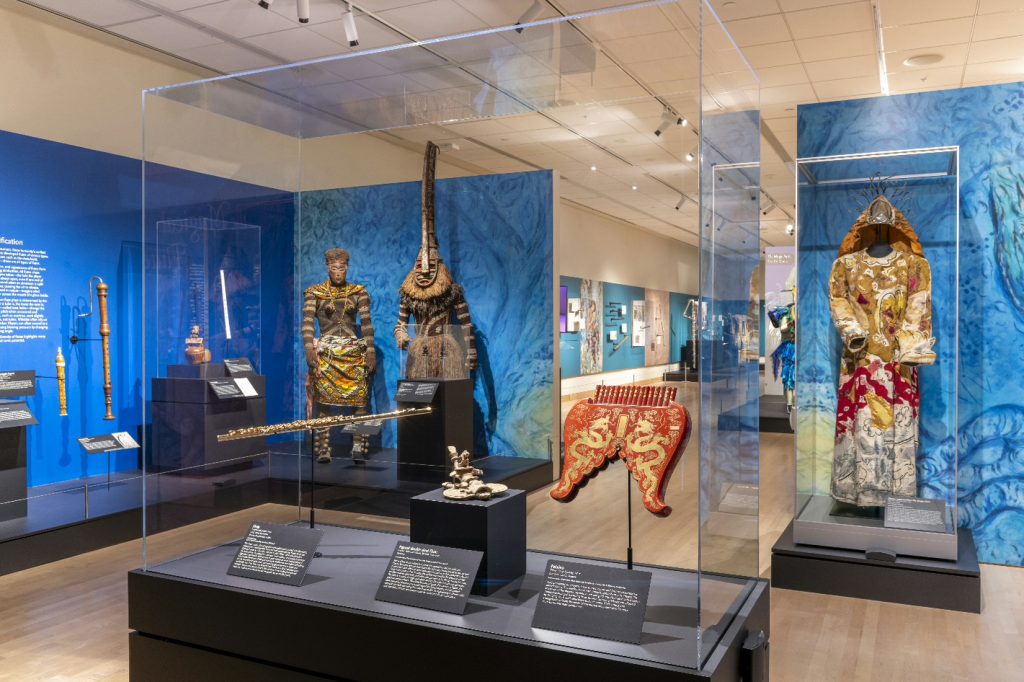
3. The exhibition features extraordinary objects — from ancient Xinglongwa bone flutes to a diamond-encrusted gold flute played by Sir James Galway.
Could you highlight a few instruments that you feel exemplify the themes of creativity, influence, and human connection?
EH: Part of the exhibition is to celebrate the flute as the world’s oldest wind instrument. One powerful example is the yue flute, crafted from a vulture’s wing bone and dating back around 8,000 years to a Neolithic culture in northeast China. Although we do not know its exact function, this flute was likely used in ceremonies or for personal expression. It’s just fascinating to think that humans have been using flutes for millennia to express emotion, communicate, and connect with the world.
We also have a pre-Columbian Vicús vessel whistle from northern coastal Peru made between 100 BCE and 100 CE. This instrument has two chambers and a small whistle; tipping or rocking it with some water inside forces air through the whistle, producing birdlike warbles, while blowing into it without water also creates sound. It’s an interesting example showing how ancient artisans innovatively combined sound, visual design, and ritual function.
The exhibition also features a group of Boehm flutes, ranging from a simple system model to Boehm’s 1832 and 1847 models. These instruments represent the evolution of Theobald Boehm’s groundbreaking redesigns, which laid the foundation for modern flutes and shaped the development of other keyed woodwinds.
4. Several flutes in the exhibition were owned or played by internationally renowned musicians such as Herbie Mann, R. Carlos Nakai, and Sir James Galway.
What role did contemporary performance history play in shaping the exhibition narrative?
EH: Contemporary performance history is so important for us to show how flutes continue to carry musical traditions and inspire new musical expressions today. Instruments associated with renowned contemporary artists — such as Sir James Galway, Herbie Mann, and R. Carlos Nakai — highlight not only their individual iconic sound and style, but also the broader artistic and cultural influence they helped shape. We also include instruments used by influential flute artists from around the world, such as the Egyptian nay master Mahmoud Effat, and the Cuban flutist Richard Egües.
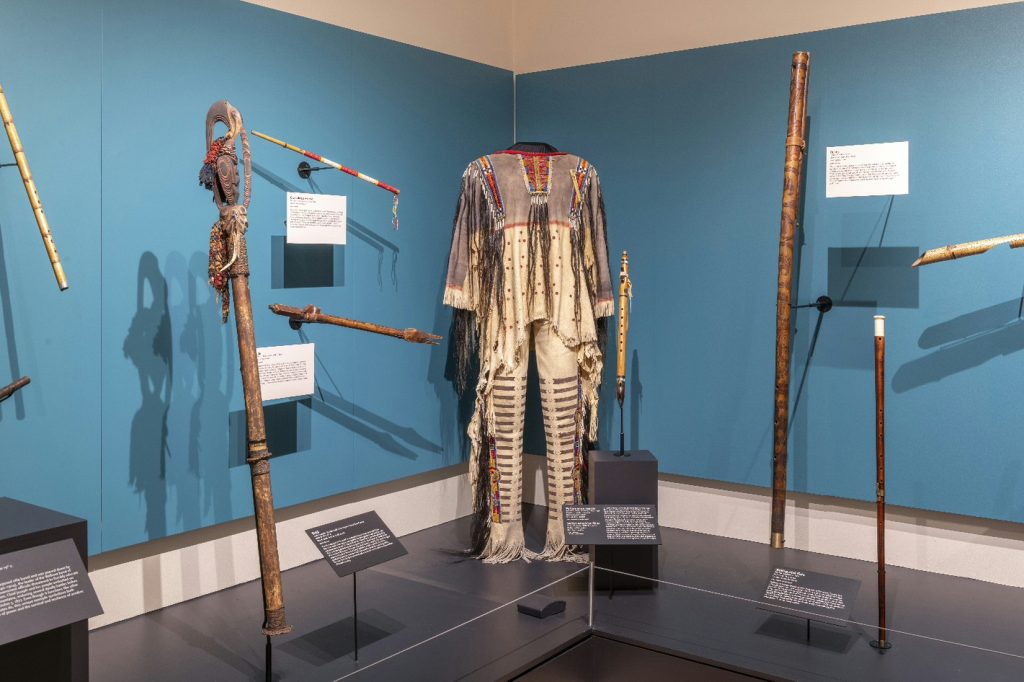
Bringing these instruments together helps us show how global flute traditions connect with modern performance practices. I think seeing the very instruments these artists played allows our guests to engage more deeply with their music and understand the legacies of those influential contemporary performers.
5. Traditional clothing, ceremonial regalia, and dramatic stage costumes (including pieces designed by Marc Chagall and Dame Zandra Rhodes for The Magic Flute) provide powerful context.
How did these visual elements help illuminate the social, symbolic, and theatrical roles of the flute?


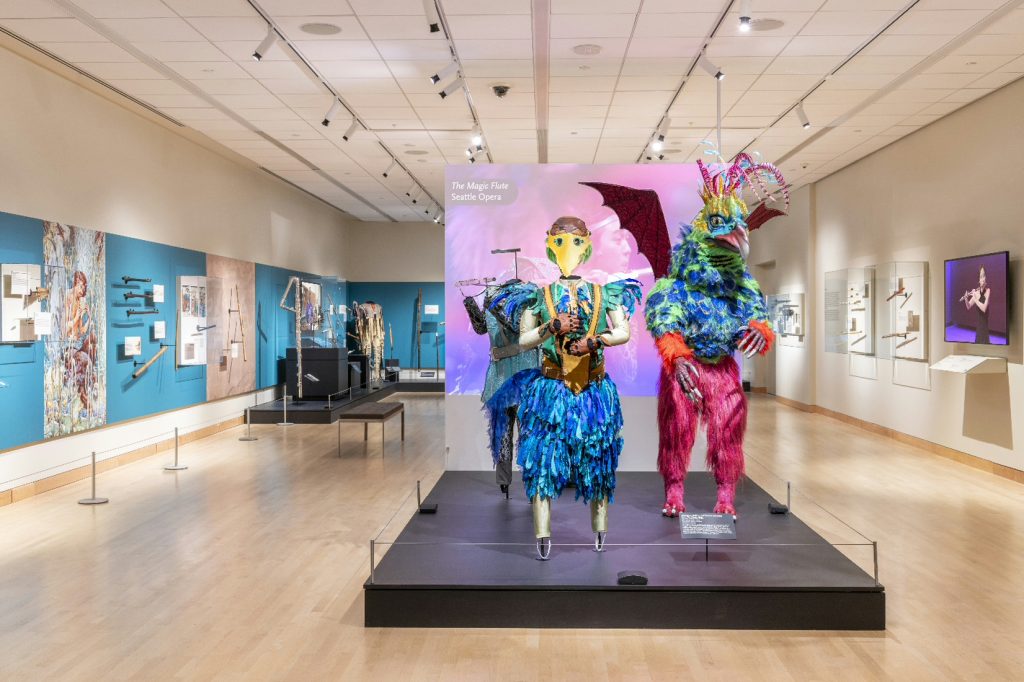
EH: The costumes and garments highlight how flutes inspire imagination and carry symbolic significance across cultures. We have a group of opera costumes from prominent productions of Mozart’s The Magic Flute, which help us to present the iconic story of the flute’s power to enchant and transform.
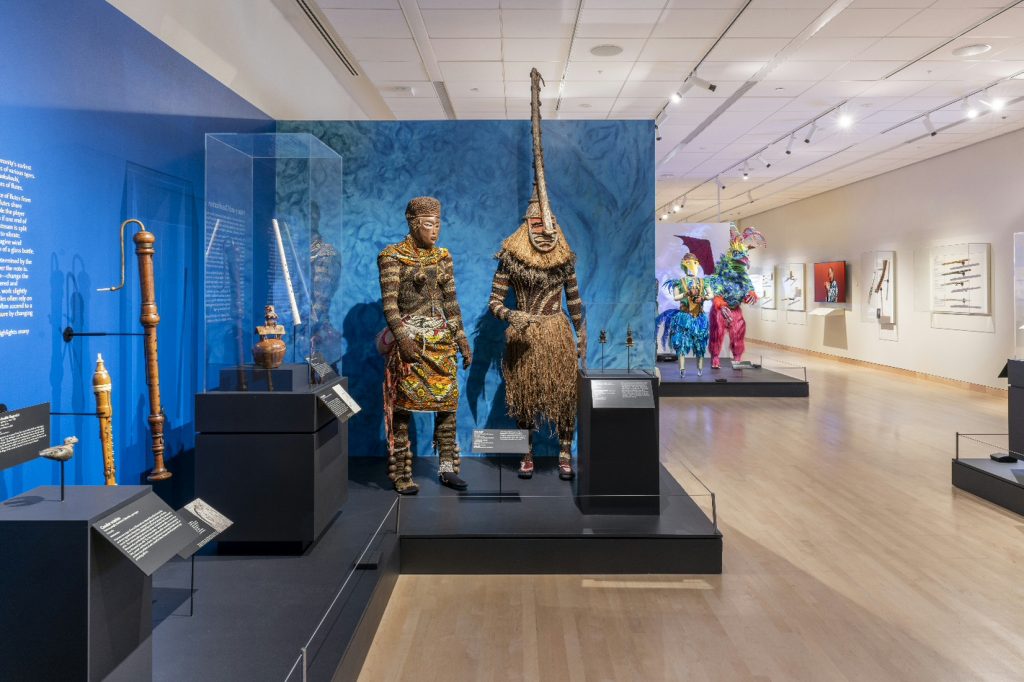
We also feature a pair of masks used by the Chokwe people of the Democratic Republic of the Congo, carved to represent ancestral spirits. Their imagery echoes the carved figures found on the two corresponding kasengosengo hunters’ whistles in the show, and those are instruments that, in Chokwe culture, are believed to be endowed with supernatural powers. This connection helps us to highlight how the flutes reflect social status and symbolic significance.
6. Video content featuring experts and virtuosos — including Jasmine Choi — brings modern artistry into the exhibition.
How did you decide which performers and voices to include, and what do these contributions add to the visitor experience?
EH: The performers and experts we invited add a really important layer to the exhibition. We were very fortunate to work with virtuosos like Jasmine Choi as well as collectors and cultural experts who have deep connections to the musical traditions represented in the show. One especially meaningful collaboration for me was with Māori instrument specialist Horomona Horo from Aotearoa New Zealand. We invited him to play two historical Māori flutes in the exhibition. Watching him interact with these instruments — hearing how he brought them to life and how he interpreted their sound — was eye-opening for me. It really reinforced how essential these voices are.
Including performers and experts allows us to go beyond presenting the instruments as mere objects. Their insights and lived experiences help our guests hear the instruments’ sounds and offer meaningful ways to understand their cultural significance and the traditions they carry.
7. In presenting flutes from vastly different time periods and societies, what key themes or connections did you hope visitors would notice?
EH: The subtitle Beauty, Enchantment, and Power really encapsulates the core themes of the exhibition. Within those three ideas, we explore several sub-themes that highlight the many ways different cultures have imbued flutes with meaning. What we hope our guests experience are the resonances across the gallery — how people, across time and across cultures, have transformed the flute into a powerful vessel that embodies rich human experience and expression.
Among several other themes, one that emerges strongly is the flute’s capacity to entice and to transcend the ordinary. In many cultures, flutes were created to enchant, to communicate with spirits, natural forces, or the supernatural. For example, some of the flutes and ocarinas from ancient Mesoamerica and the Andes feature distinctive forms, symbolism, and sounds that reflect ideas about life, death, renewal, and the cyclical patterns of the natural world.
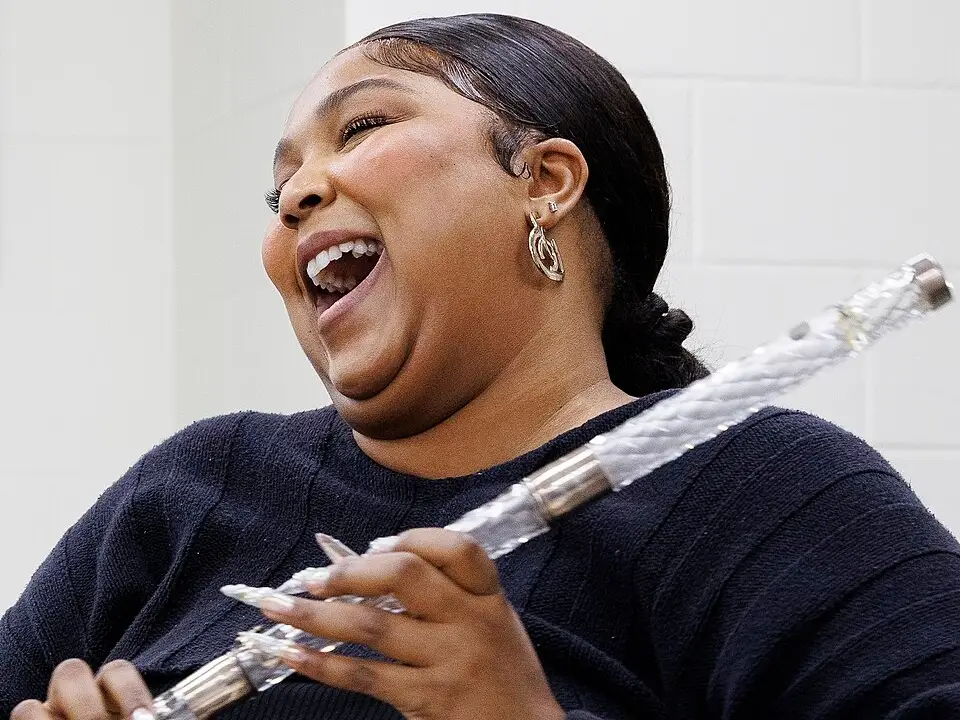
Another important thread is the association between flutes, status, and identity. Several instruments in the exhibition are truly one-of-a-kind and were crafted for individuals of special standing — royalty, such as Napoleon Bonaparte’s crystal flute and Japanese emperor Go-Daigo’s hitoyogiri; ceremonial specialists; or influential musicians like Sir James Galway and R. Carlos Nakai, who had custom instruments made. Some flutes functioned as ritual objects believed to possess specialized powers, signaling social status, especially in ceremonial contexts. Together, these flutes’ distinctive designs and, in some cases, unparalleled refinement highlight how flutes intersect with status, identity, and power, offering diverse ways to experience beauty and imagination.
8. Finally, for international readers who cannot travel to Phoenix, are there digital resources, publications, or future plans that would allow them to experience elements of The Magical Flute remotely?
EH: While the exhibition is designed to provide an immersive in-person experience at MIM, we also offer some digital and print resources for those who cannot visit to explore. The exhibition catalog is available for purchase in MIM’s store. Additionally, our YouTube channel and other social media platforms feature videos highlighting select objects, artist features, and behind-the-scenes insights.
The catalog for The Magical Flute: Beauty, Enchantment, and Power is available for purchase at the Museum Store or online at theMIMstore.org.
Explore the exhibition further through the videos below, highlighting its instruments and stories.
Watch curators Matt Zeller and Eddie Hsu discuss the exhibition on Arizona Horizon:
Renowned flutist Jasmine Choi demonstrates Sir James Galway’s legendary flute.
See this instrument and more than 100 exceptional flutes in The Magical Flute: Beauty, Enchantment, and Power at the Musical Instrument Museum. Sponsored by the John & Joan D’Addario Foundation, Mary Ann & John Mangels, and PNC Bank. Gift of the Robert J. Ulrich and Diane Sillik Fund.
Opera comes to life through costume.
The Magical Flute: Beauty, Enchantment, and Power features iconic stage costumes from Mozart’s The Magic Flute, including Papageno’s legendary look — previewed here by Arizona Opera’s Mauricio Perusquia. Costumes courtesy of the Metropolitan Opera Archives and Seattle Opera.
Yulia Berry
www.yuliavberry.com
Yulia Berry, DMA, is an award-winning flutist and renowned flute pedagogue with over 30 years of international teaching and performing experience. She leads a thriving Yulia Berry’s Flute Studio and is the founder of the New England Flute Institute, where her students consistently achieve top honors and festival placements.
Dr. Berry is the founder and editorial director of Flute Almanac, a global digital platform for flutists that features a multilingual magazine, international event listings, news, reviews, and educational content. Since its launch in 2024, Flute Almanac has quickly become an essential resource for the worldwide flute community. It is widely recognized as a leading flute magazine, receiving recognition from Google as the #1 global flute magazine.
She also founded The Babel Flute and Web Flute Academy, and in 2024, spearheaded the Global Flute Excellence Awards – a groundbreaking international initiative supported by Sir James and Lady Jeanne Galway. The awards recognized outstanding flutists, composers, educators, and flute makers, and brought together 52 judges from 19 countries.
Honored in Marquis Who’s Who 2024 for her exceptional achievements in music, Yulia Berry continues to shape the global flute community through innovation, education, and inspired leadership.