Three years ago, in December 2022, I wrote an extensive article for The Babel Flute titled “Important Lessons for Flutists from Leonardo da Vinci,” exploring how the great Renaissance master’s creativity, curiosity, and universal way of thinking can inspire modern musicians. That article grew out of my deep admiration for Leonardo — an admiration that has only intensified over time. I remain endlessly fascinated by his boundless intellect, artistic vision, and multidimensional approach to knowledge, and I often find myself returning to study his persona, reread his notebooks, and reflect on how his ideas continue to illuminate the path of musical growth today.
Today, we will talk about Leonardo da Vinci in a different way — through his remarkable to-do lists, and what they can teach us as flutists.
Most of us keep to-do lists. They live in notebooks, sticky notes, or sleek apps like Todoist, Notion, or Trello. They’re filled with reminders that keep daily life on track:
- buy groceries
- practice long tones
- schedule a lesson with my teacher
- send that email
Useful? Yes. Inspiring? Not usually.
But Leonardo da Vinci’s to-do lists were different. They weren’t about errands. They were maps of curiosity — a blueprint for genius.
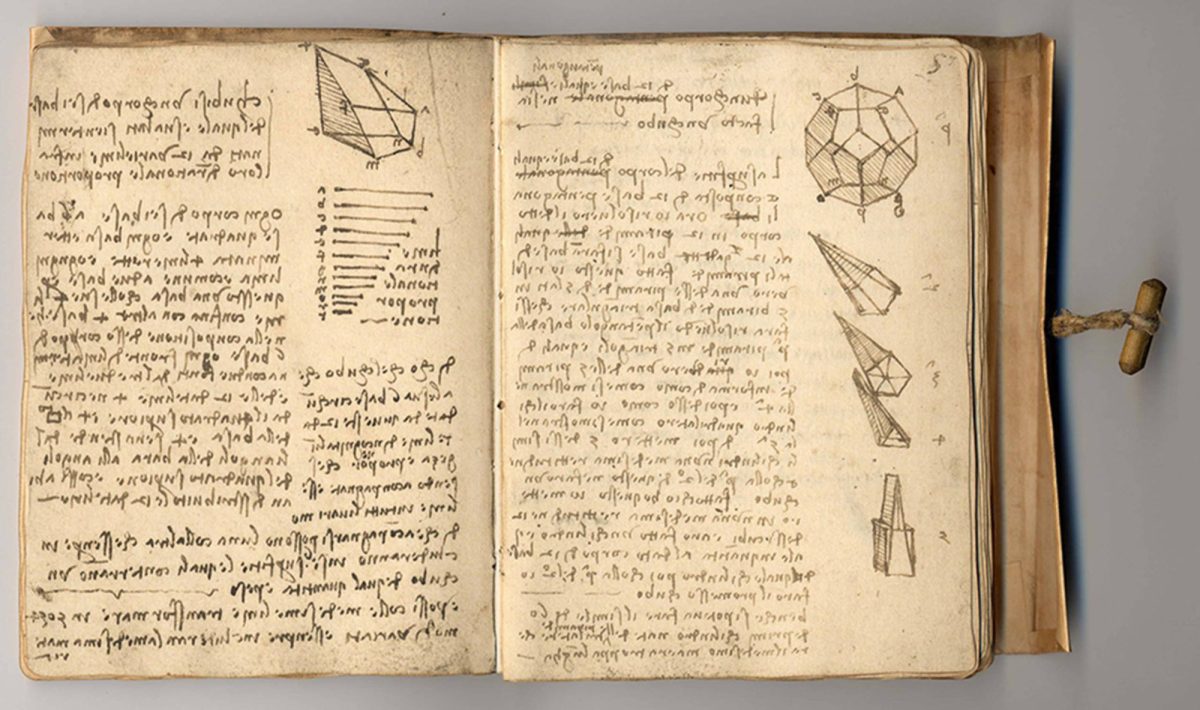
A Glimpse into Da Vinci’s Notebook
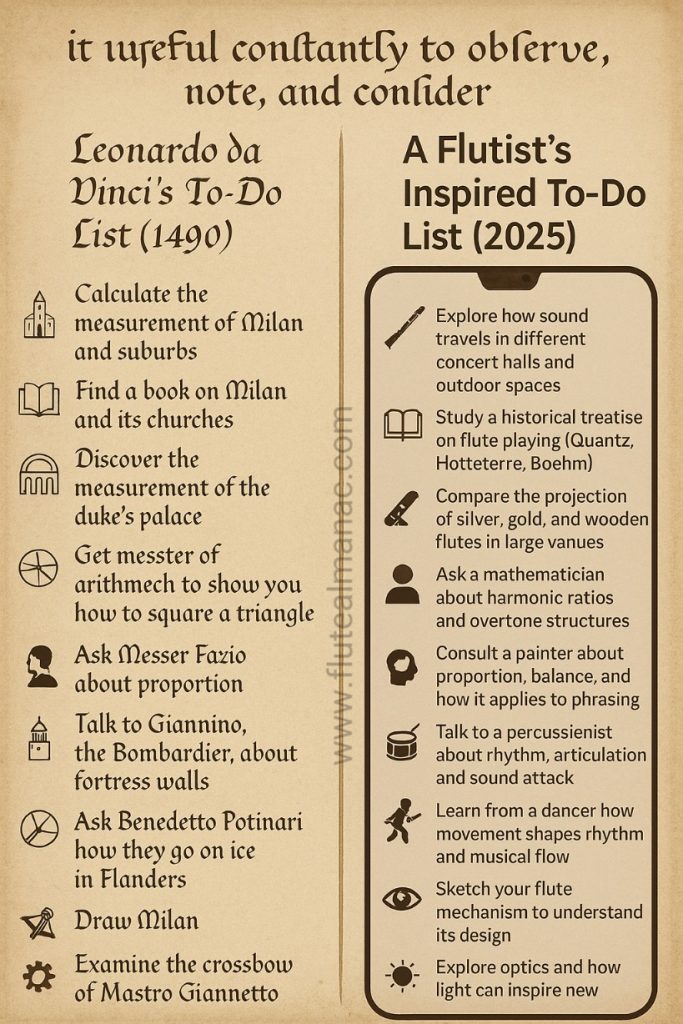
Around 1490, Leonardo scribbled down this list in one of his notebooks:
- [Calculate] the measurement of Milan and suburbs
- [Find] a book that treats of Milan and its churches
- [Discover] the measurement of the duke’s palace
- Get the master of arithmetic to show you how to square a triangle
- Ask Messer Fazio (professor in Pavia) about proportion
- Talk to Giannino, the Bombardier, about how the tower of Ferrara is walled
- Ask Benedetto Potinari how they go on ice in Flanders
- Draw Milan
- Examine the crossbow of Mastro Giannetto
- Find a master of hydraulics to explain canals and mills
- Try to get Vitolone’s book on optics
What strikes us immediately is scope. This isn’t a list of chores. It’s a manifesto of exploration: mathematics, engineering, optics, anatomy, even ice-skating techniques in distant lands. Leonardo’s lists were never small-minded. They remind us that genius grows out of restless curiosity.
What Flutists Can Learn
Now compare that to a typical flutist’s to-do list:
- practice scales
- record audition excerpts
- order new cork grease
- update teaching schedule
Efficient? Yes. Transformative? Not quite.
Imagine rewriting your own list in Leonardo’s style. Instead of just practicing scales, what if you added:
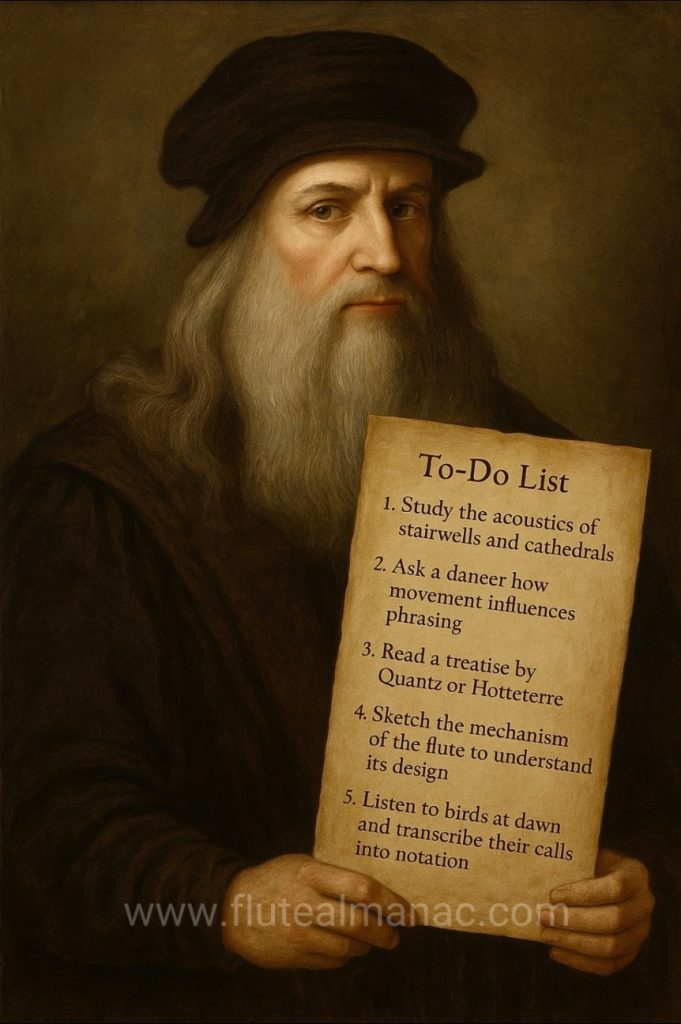
- Study the acoustics of stairwells and cathedrals
- Ask a dancer how movement influences phrasing
- Read a treatise by Quantz or Hotteterre
- Sketch the mechanism of the flute to understand its design
- Compare the resonance of silver, gold, and wooden flutes in different climates
- Listen to birds at dawn and transcribe their calls into notation
Suddenly, the list isn’t just about survival or maintenance — it’s about expansion, discovery, and artistry.
To-Do Lists Then and Now


Today, we carry digital tools Leonardo couldn’t imagine. Our phones remind us to practice, sync rehearsals to calendars, and even analyze practice sessions with apps like Modacity or Tonara. But what if, alongside reminders for etudes and ensemble rehearsals, we inserted a few da Vinci-style ambitions?
Instead of “30 minutes of Taffanel & Gaubert,” how about:
- Discover how flute tone changes in extreme temperatures.
- Ask a physicist about turbulence inside the embouchure hole.
- Plan a recital program inspired by mythology.
- Explore the connection between breath in yoga and flute phrasing.
The Genius of Leonardo’s Lists
Da Vinci’s genius wasn’t only in his art or inventions. It was in his way of approaching knowledge. He refused to silo disciplines. Mathematics informed painting. Anatomy informed sculpture. Mechanics informed music.
For flutists, this is the ultimate reminder: don’t reduce your art to a checklist of scales and excerpts. Let curiosity leak into your list. Learn from science, history, architecture, poetry, and the natural world. Great artistry grows where disciplines collide.
Dream Bigger, Observe More
Leonardo once wrote:
“It is useful constantly to observe, note, and consider.”
That’s the real to-do list for flutists:
- Observe — the world, the sound, the movement of others.
- Note — questions, inspirations, discoveries.
- Consider — how they connect, how they shape your playing.
When your list goes beyond errands and practice logs, it becomes a Renaissance plan for growth. Just as Leonardo casually wrote “Draw Milan,” maybe we should dare to write:
“Reimagine the future of the flute.”
Because genius begins with what we choose to write down.
Yulia Berry
www.yuliavberry.com
Yulia Berry, DMA, is an award-winning flutist and renowned flute pedagogue with over 30 years of international teaching and performing experience. She leads a thriving Yulia Berry’s Flute Studio and is the founder of the New England Flute Institute, where her students consistently achieve top honors and festival placements.
Dr. Berry is the founder and editorial director of Flute Almanac, a global digital platform for flutists that features a multilingual magazine, international event listings, news, reviews, and educational content. Since its launch in 2024, Flute Almanac has quickly become an essential resource for the worldwide flute community. It is widely recognized as a leading flute magazine, receiving recognition from Google as the #1 global flute magazine.
She also founded The Babel Flute and Web Flute Academy, and in 2024, spearheaded the Global Flute Excellence Awards – a groundbreaking international initiative supported by Sir James and Lady Jeanne Galway. The awards recognized outstanding flutists, composers, educators, and flute makers, and brought together 52 judges from 19 countries.
Honored in Marquis Who’s Who 2024 for her exceptional achievements in music, Yulia Berry continues to shape the global flute community through innovation, education, and inspired leadership.