

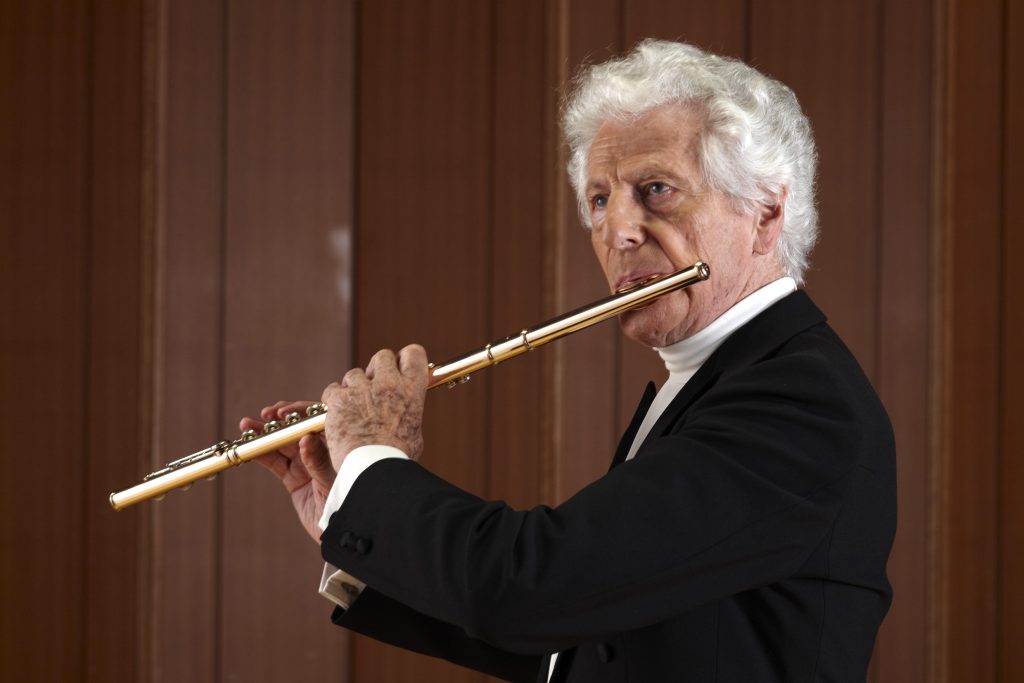
The international flute community mourns the passing of Peter-Lukas Graf, one of the most distinguished and intellectually influential flutists of the 20th and early 21st centuries. He passed away just days short of his 97th birthday, leaving behind a legacy defined not only by extraordinary artistry, but by a rare depth of musical thought, integrity, and pedagogical clarity.
Born on 5 January 1929 in Zürich, Switzerland, Graf belonged to a generation of musicians for whom the flute was never an end in itself, but a vehicle for musical meaning. Throughout a career that spanned more than seven decades, he embodied a profoundly humanistic approach to music-making — one rooted in structure, line, expression, and communication.
A Formation at the Highest Level
Peter-Lukas Graf studied flute with André Jaunet in Zürich, before continuing his studies in Paris with Marcel Moyse and Roger Cortet at the Conservatoire National de Paris. There, he was awarded First Prize as a flutist as well as the Conductors Diploma — an early sign of the dual artistic path that would shape his life.
He further pursued conducting studies in Munich, laying the groundwork for a career that would seamlessly unite flute performance, orchestral leadership, and opera.
International Recognition at a Young Age
At just 21 years old, Graf achieved international acclaim with his recording of Jacques Ibert’s Flute Concerto, a performance that immediately established him as a major artistic voice. Soon after, he won First Prize at the prestigious ARD International Music Competition in Munich, as well as the Bablock Prize of the Harriet Cohen International Music Awards in London.
He was appointed the youngest principal flutist of the Winterthur Symphony Orchestra and performed with the Lucerne Festival Orchestra, often combining flute performance with conducting responsibilities. This unique versatility led him into a period devoted entirely to opera and symphonic conducting, including work at the Lucerne Opera and as a guest conductor with orchestras around the world.
Performer, Conductor, Thinker
Graf’s career defied narrow categorization. He performed extensively as a soloist and chamber musician, appeared at major international festivals, and made more than forty solo and chamber recordings. His recording of the Krommer concertos with the English Chamber Orchestra was awarded the Grand Prix International du Disque.
Yet what set Peter-Lukas Graf apart was not virtuosity for its own sake. As John Bailey observed in his presentation speech for the National Flute Association’s Lifetime Achievement Award:
“For Mr. Graf, the flute is only a means to an end — his thought is not about the instrument but about the musical expression: the line, the architecture and structure of the music, intelligent phrasing, and above all, communication.”
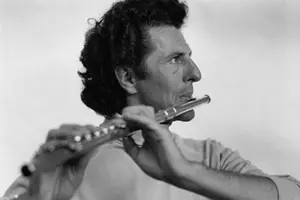
This philosophy permeated everything he did.
A Teacher of Lasting Influence
From 1973 onward, Graf served for more than two decades as Professor of Flute at the Basel Music Academy, shaping generations of flutists through his demanding yet profoundly musical approach. Even after retiring from his formal post, he continued to give masterclasses internationally, remaining an active and respected pedagogical voice well into later life.
His influence extended far beyond the classroom through his written work. His didactic monographs — Check-Up, Interpretation: How to Shape a Melodic Line, and The Singing Flute (all published by Schott) — have become essential reading for serious flutists worldwide, valued for their clarity, musical intelligence, and timeless relevance.
Honors and Recognition
Peter-Lukas Graf’s contributions were recognized by numerous international honors, including:
- Doctor honoris causa from the Academy of Music in Kraków
- Lifetime Achievement Award from the National Flute Association (USA), 2005
- Premio alla Carriera – Flauto d’Oro from the Italian FALAUT Association
He also held a special place in the personal histories of many leading musicians; among many notable moments, he performed at James Galway’s wedding in 1972 — a testament to the respect he commanded among his peers.
A Musical Legacy Beyond the Instrument
In interviews, Graf repeatedly emphasized that his goal was to make the listener forget the flute and hear only the music. In a 1983 conversation published in Gespräche mit Flötisten, he reflected:
“To play so that the listener forgets the flute; so that he listens to the music and no longer thinks about the instrument…”
And later, in words that now read like a quiet farewell:
“Music lives, and everything alive constantly changes. One never stops learning. Such is life, and such is music.”
Remembering Peter-Lukas Graf
Peter-Lukas Graf leaves behind not only recordings, books, and honors, but something far more enduring: a way of thinking about music that continues to challenge, inspire, and elevate those who encounter it.
His legacy lives on in the countless flutists, conductors, and teachers shaped by his ideas — and in every musical line played with intelligence, honesty, and purpose.
He will be remembered with deep respect, gratitude, and admiration by the global flute community.


Hermosa remembranza sobre el legado de una leyenda de la flauta.