A single tone is vibration. A phrase is meaning.
We often hear that sound is vibration.
Sound is not just what we hear. It is what we understand.
That it is pressure moving through air.
That it travels in waves.
That it enters the body and affects the nervous system.
All of this is true.
But it is not the whole truth.
Because if sound were only vibration,
then every tone would mean the same thing.
And it doesn’t.
Two people can play the same note on the flute.
Same pitch.
Same dynamic.
Same instrument.
And yet —
one sound feels empty,
and the other feels like it is speaking.
Why?
Because sound is not just what is produced.
It is what is shaped.
In recent years, there has been growing interest in the idea that sound affects the body — that it organizes matter, influences emotion, and even shapes our internal state.
We see this in discussions of vibration, cymatics, and sound therapy.
And again — there is truth here.
Sound does affect us.
It can calm the breath.
It can raise tension.
It can shift the entire atmosphere of a room.
But something deeper is happening.
Something that science alone does not fully explain.
The Missing Piece
Sound becomes powerful not simply because it exists,
but because it is organized in time.
A single tone is vibration.
A phrase is meaning.
When a musician plays, they are not releasing sound.
They are shaping:
- direction
- tension
- release
- silence
They are creating relationships between sounds.
And meaning lives in those relationships.
This is why the same melody can feel:
like a question
like an answer
like longing
like peace
The vibration is similar.
The meaning is not.
Why This Matters More Than Ever
We live in a world filled with sound.
Constant sound.



Music.
Voices.
Noise.
Media.
Fragments of rhythm and speech surrounding us all the time.
And yes — this affects us.
But not only because of frequency or volume.
It affects us because of how that sound is structured.
Because of what it carries.
Because of how it is shaped.
A chaotic soundscape creates tension.
A coherent one creates space.
A harsh tone can close us.
A shaped tone can open something we didn’t know was there.
This is something musicians understand instinctively.
Especially flutists.
This instinctive focus on line and expression is deeply rooted in how flutists are trained. We explore this further in Why Flutists Think Melodically — and what this approach can sometimes overlook.
Because the flute reveals something very direct:
Sound is born from breath —
and breath is already part of the body.
There is no separation.
From Vibration to Meaning
Before sound becomes meaning,
it is vibration.
But it becomes meaning only through:
- intention
- structure
- listening
Not every sound becomes music.
And not every vibration becomes something we understand.
This transformation — from vibration to meaning — is not automatic.
It is shaped.
It is learned.
It is refined over time.
And it is at the heart of what it means to truly interpret music.
A Deeper Perspective
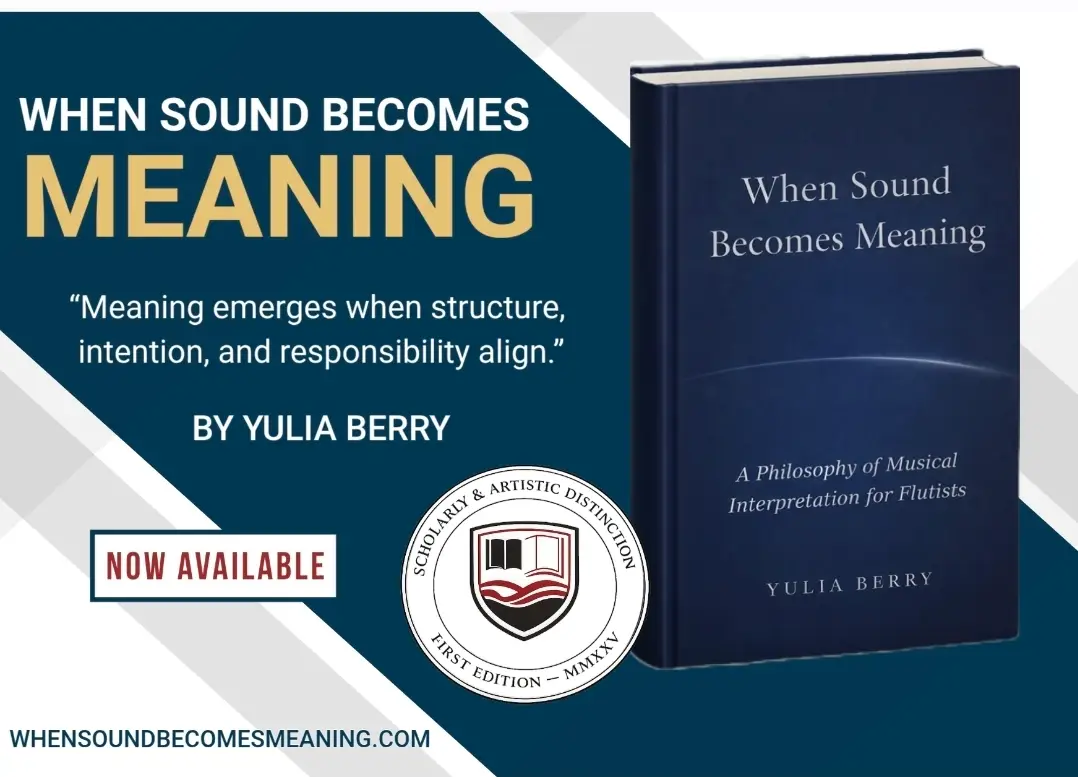
This idea is explored more fully in When Sound Becomes Meaning, where sound is understood not as a passive phenomenon, but as something that unfolds through perception, structure, and artistic responsibility.
Because what we hear is never just sound.
It is shaped thought.
It is intention made audible.
It is meaning in motion.
The Quiet Power of Sound
So yes, sound moves through the body.
Yes, it affects the nervous system.
Yes, it can calm or disturb.
But its deepest power lies elsewhere.
Not in what it does to us.
But in what it becomes through us.
Sound does not simply fill space.
It creates it.
And when shaped with awareness,
it becomes something far greater than vibration.
It becomes meaning.
This understanding of sound as structured meaning is not new. It lies at the very foundation of great musical thought — and few composers embody it more clearly than Johann Sebastian Bach.
Tomorrow, on Bach’s birthday, we will explore how his music reveals sound not as vibration alone, but as living, organized thought in time.