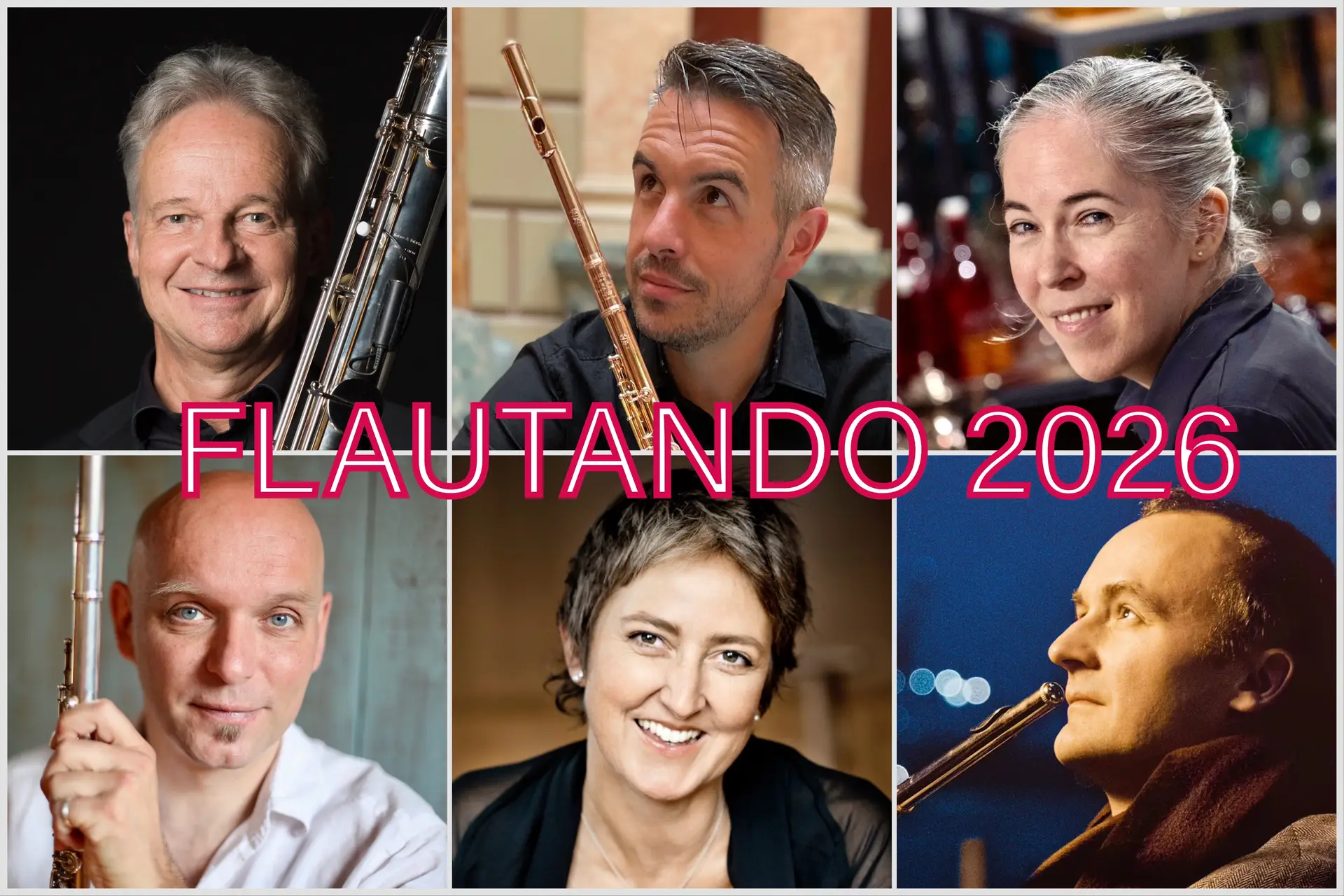
In January 2026, Flautando invited guests to the Künstlerhaus Boswil for the 26th time, turning the venue into the centre of the flute world for a day. Organiser Stefan Keller had chosen «The Magic of the Flute» as the theme for the day, and it truly was a magical day, brought to life by lecturers Gudrun Hinze, Tilmann Dehnhard, Philipp Jundt, Gareth McLearnon and Stefan Keller with a wide variety of topics.
At the beginning, Stefan Keller remembered the recently deceased Peter-Lukas Graf, who had been a guest in Boswil four times, most recently in 2023 with a Peter-Lukas Graf special event!
Keller read from the last chapter of Graf’s book «Backstage», entitled «Good Advice», in which P.-L. Graf wishes us all that we may never lose our sense of wonder:
«Marvel at the wonders of nature, marvel at life, marvel at the great works of art! For when we marvel, we usually also find reason to be grateful.»
Beginning the Day: Sound, Breath, and Wonder
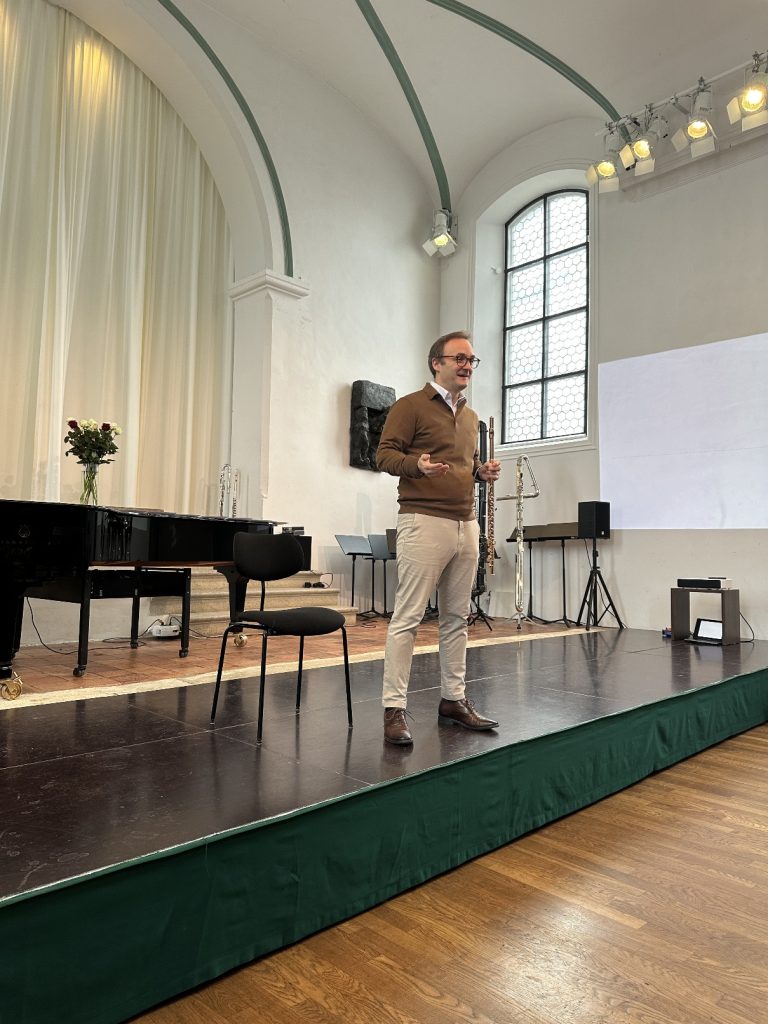
The «warm up!» began with Swiss flutist Philipp Jundt and his liberating thought that the first notes of the day don’t have to be perfect. Rather, the beginning of daily playing is about building a relationship with the instrument and one’s own breath. He referred to an exercise by Aurèle Nicolet, who believed that one should start the day in a grand and open manner. It is not so easy to raise your arm and blow into the flute as you let it fall, without immediately falling into the pattern of holding, guiding and pushing the tone.
In combination with Moyse’s two-tone exercise, however, I became increasingly able to play in a relaxed manner and was then surprised by the beauty of my own sound. The very vivid image of «cold air» with a narrow lip opening and «warm air», as when breathing, which Jundt demonstrated clearly audibly, was immediately applied by my students the following week – with wonderful success!
Discipline Over Motivation
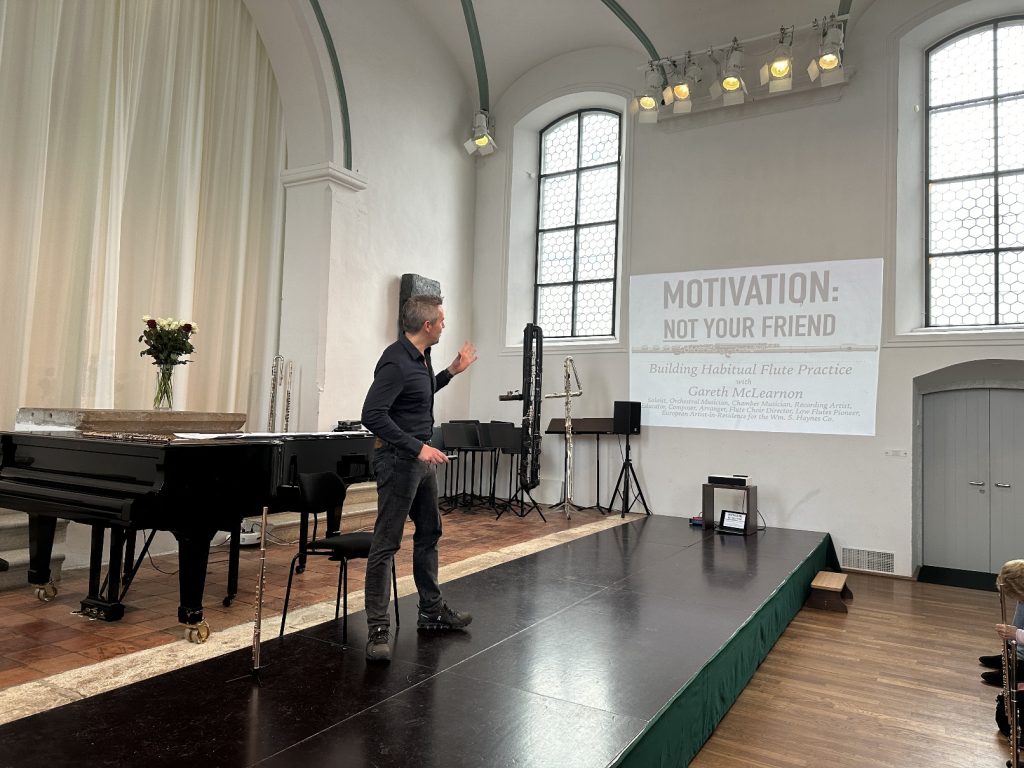
We are all familiar with the problem of motivation when practising scales or similar exercises, or rather the problem of losing motivation. We hear a great concert, are inspired and resolve to practise every day in a structured, diligent and consistent manner from now on. And then? Then our inner demons strike, and after a short time we are caught in the old pattern and disappointed in ourselves.
Irish flautist Gareth McLearnon addressed this very tragedy in his lecture «Motivation – not your thing?» His message is clear: motivation is not our friend!
Using his own journey from couch potato to someone for whom daily exercise is as much a part of life as eating and sleeping, he traced the path that truly leads to success. The magic formula is not motivation, but discipline that becomes a habit! Discipline to practise scales in all positions, rhythmic patterns and variations. It should not be forgotten that sound always comes first!
Only then do tempo, consistency, articulation and the like come into play. Whether one should practise using a sophisticated key system with daily mobile phone reminders or take a more relaxed approach is open to debate; however, it is undeniable that no one has ever sung the praises of discipline more charmingly than me. So let’s not wait until we feel motivated to practise, but let’s be disciplined and get started, and then the motivation will often come naturally as we do it.
To quote Goethe: Success has three letters: DO! Or in Gareth McLearnon’s words:
«Motivation is not your friend. Discipline is your friend and habit is your best friend!»
More Playing – More Fun
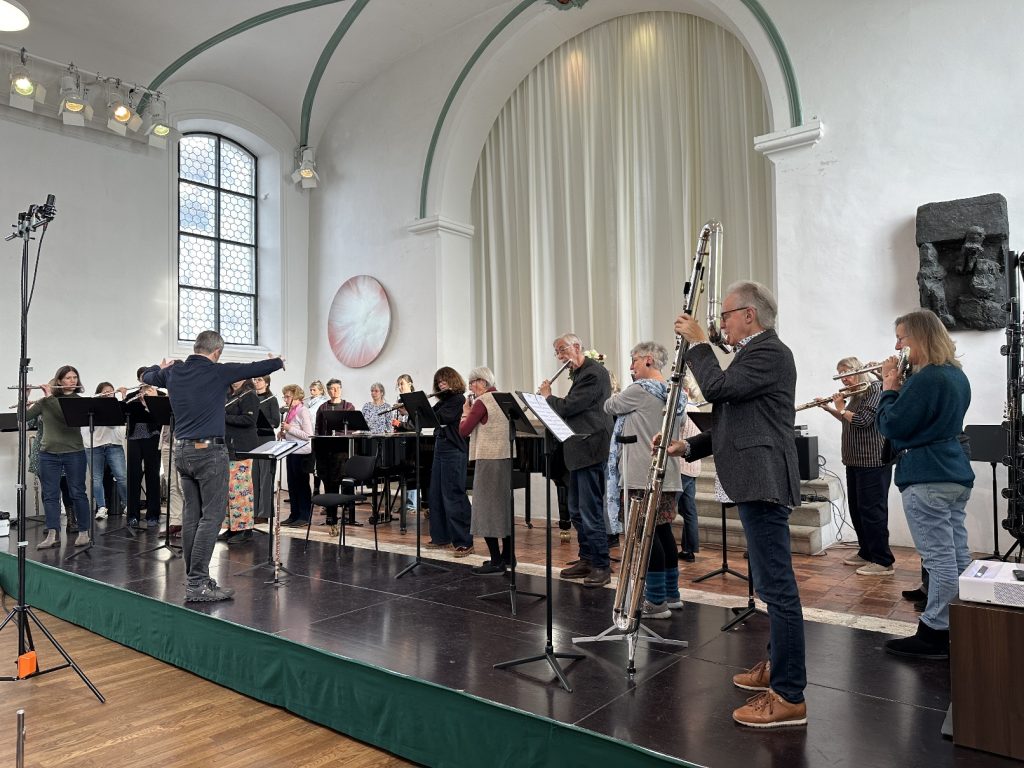
After this impressive and powerful programme item, Gareth McLearnon invited everyone onto the stage to play a piece written especially for large flute ensembles under the motto «More playing – more fun!».
The calm, meditative piece, under Gareth’s expert direction, left all the players entranced. The sound of thirty flutes of various sizes merged into a unified whole.
Sound Painting and Collective Improvisation
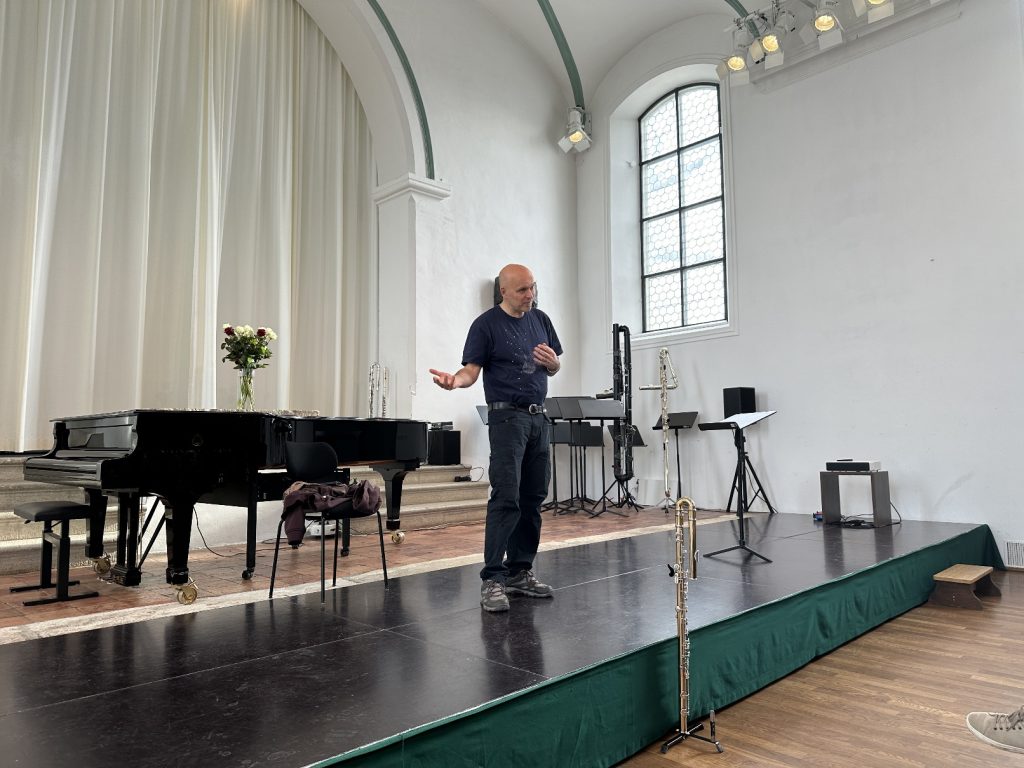
It was clear from the moment he stepped onto the stage that Berlin flutist Tilmann Dehnhard is passionate about his topic, «sound painting.» Most of the course participants probably had no concrete idea of the creative possibilities hidden behind the term «sound painting.» Dehnhard gave a rousing explanation of the basic idea. It’s about improvising in the group which is led by a conductor using agreed gestures for, e.g., dynamics, changes in pitch, density of the notes to be played, cues for soloists, etc.
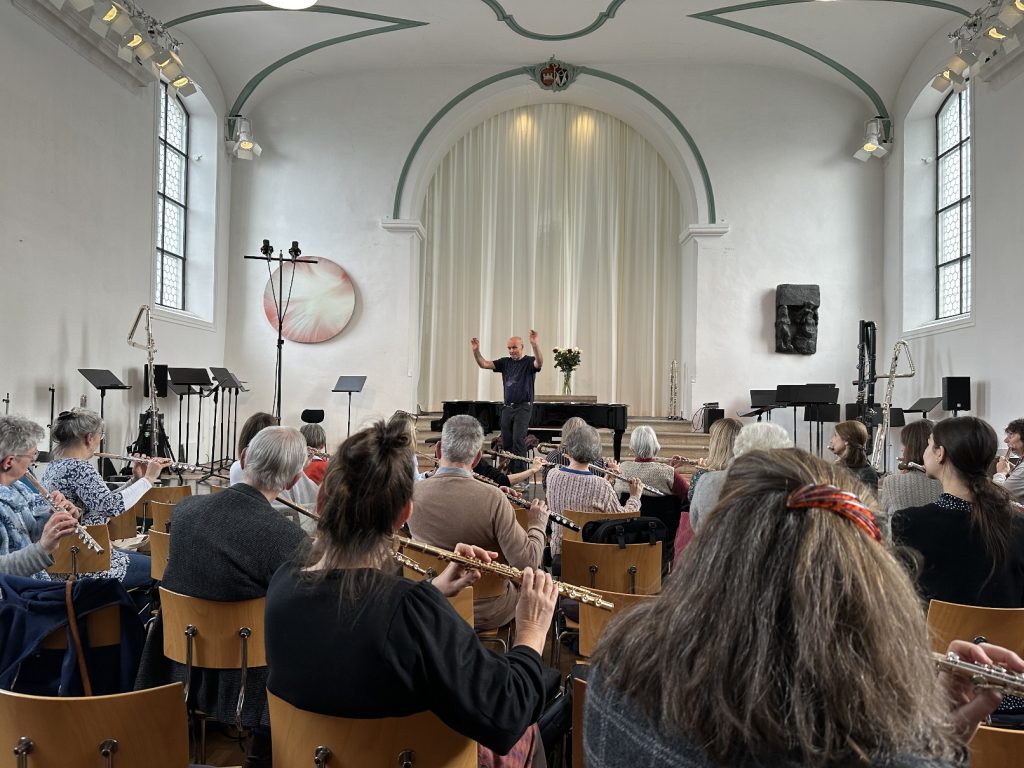
He immediately illustrated this in several group improvisations with the participants, and gradually the principle and the conducting gestures became clear, and the sound result was impressive. Since it is great fun and everyone can contribute with their abilities, regardless of their level, it is an extremely peaceful way to make music together. Especially since the conductor directs the musical events, but must react equally to what the other players contribute, making it a give-and-take process. Sound painting is a fascinating experience for anyone who has not yet dared to improvise.
The World of Low Flutes
The last workshop of the morning was devoted to «low flutes in everyday life». To set the mood, Gareth McLearnon and Stefan Keller played a Telemann duet, arranged by Gareth especially for this occasion, with all possible combinations of flutes, so that both had to change instruments repeatedly: from the concert flute to the alto, bass, contrabass and subcontrabass flutes, all were used.
McLearnon, who is also very active in recording film music, explained that low flutes have become particularly popular with film composers in recent years, as their sound is relatively unfamiliar to audiences and can therefore contribute to a novel sound experience.
The bass flute is also wonderfully suited for duets with inexperienced young flute players, who often still have difficulty distinguishing their own playing from that of the other voice. The bass flute creates an additional space that can be very helpful for orientation.
A long-standing tradition of the Flautando Day is the flute exhibition, where during the breaks you can try out flutes made of silver, gold, Aurumite, wood or brass to your heart’s content and talk shop with the experts. An absolute treat!
Solar and Lunar Breathing
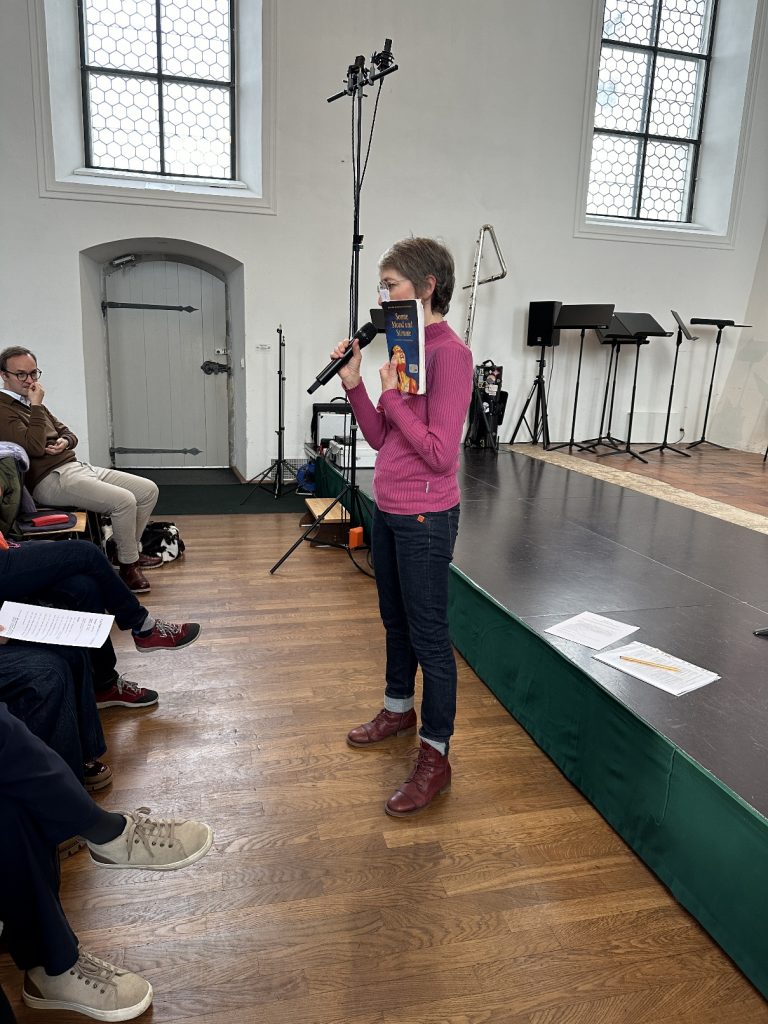
After a delicious lunch at the Künstlerhaus and stimulating conversations with participants, Gudrun Hinze, solo piccolo player in the Leipzig Gewandhaus Orchestra, familiarised us with the «solar and lunar breathing types».
Breathing is a key issue when playing the flute, but many students only receive vague instructions to breathe «into their stomach» during their first years of learning.
For some, this may lead to acceptable results, but for others it tends to cause tension and frustration. Hinze explained why this is the case by pointing out that there are two different types of breathing. Inhalers enjoy inhaling and exhaling rather passively, while exhalers do the opposite. Which type you belong to is determined at the moment of birth, the geographical location and the energy of the sun and moon at that time.
The sceptics among the audience lost all doubt about the validity of this approach in the two demonstrations that followed. With her empathetic manner, Hinze guided her two test subjects towards playing the flute in a way that corresponded to their breathing type. The differences in sound were enormous and made the audience want to explore this important topic in more depth.
Articulation in the Baroque Tradition

Philipp Jundt tackled the hot topic of «articulation in Baroque music». Whereas today flute players are judged on the beauty of their tone, in the 18th century it was articulation that impressed audiences. Using the second movement of Bach’s C major sonata, beautifully played by young participant Momo Blösch, Jundt drew on his deep expertise and a refreshing touch of light-heartedness to highlight the differences between Quantz and Hotteterre, Tromlitz and Devienne, and French and German flute schools.

The flutist effortlessly and immediately implemented all of the articulations presented by Philipp Jundt. Chapeau! To put it somewhat exaggeratedly, Jundt said that you can do nothing wrong and everything wrong, depending on which flute tradition you refer to.
Flutebeatboxing and Experimentation
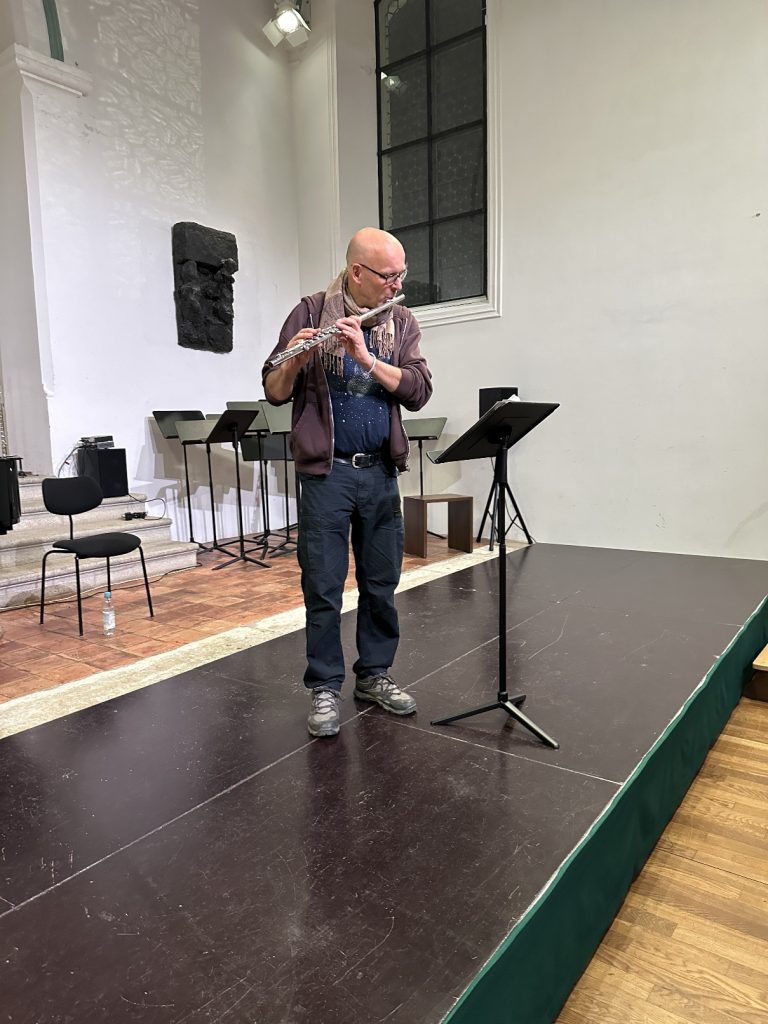
The last workshop of the day once again called for a spirit of experimentation from the participants. During «Flutebeatboxing» with Tilmann Dehnhard, the well-known «Pizze-Katze» was conjured up, lots of things were tried out, there was even more squeaking and hearty laughter. A workshop day couldn’t end more beautifully this day called «The Magic of the Flute».
A Concert Without Interruption
In the evening, there was a «surprise-surround-concert» with all the day’s lecturers and Simone Keller on the grand piano, accompanying them with her wonderfully powerful, dark sound, great nuance and tremendous commitment.
The concept of the concert was 70 minutes of music without interruption, pieces from all eras and styles, seamlessly connected by intermezzos that enticed the audience to dream and marvel.
From Bach to Beatboxing: The Evening Programme
The concert was framed by two pieces from Bach’s Brandenburg Concerto No. 3 in G major, in which all five flutists joined together to form a balanced quintet. Philipp Jundt played Reinecke’s sonata «Undine» with fairy-tale beauty, followed by «Hall of Ghosts», which was composed by Amanda Harberg in 2020 especially for Gudrun Hinze and the concert hall of the Gewandhaus. The little piccolo searches and questions the empty space before a contrapuntal dialogue between the instrument and time unfolds in the second part.
Gareth McLearnon impressed with Ian Clark’s «Zoom Tube». Tilmann Dehnhard surprised with his arrangement of Bach’s «Bourée». Modern playing techniques, artfully alternated and combined, yet full of transparency and clarity, mixed with high-level floodboxing. In Gareth McLearnon’s composition «Roots», he transported the audience to his native Ireland.
The swaying melodies were unmistakable, immediately conjuring up images of an Irish pub, dancing people and green expanses. The subsequent intermezzo, played by Stefan Keller on the subcontrabass flute, filled the church with a pleasant vibration.
What can one write about «Wake up!», the «classic» by Tilmann Dehnhard? This dialogue between an alarm clock and a piccolo, or should one say, the struggle between getting up and pulling the covers over one’s head? Even after all these years, it is still a piece that brings a happy smile to one’s face simply because of its creative idea.
In sharp contrast, «Sharpening the Blade» by Gareth McLearnon for solo contrabass flute impressively demonstrated his quality as a composer and performer. Archaic in its execution and very impressive. In Daniel Dorff’s «Perfect Storm», Gudrun Hinze, Piccolo and Phillipp Jundt, concert flute, skilfully and dynamically accompanied by Simone Keller on the piano. The different movements alternated, sometimes full of energy, sometimes lyrical and loving, but always performed to the highest standard by the performers.
Finally, Stefan Keller was inspired by Paul Desmond and expanded «Take five & more …» with baroque motifs from J.S. Bach’s E minor sonata, echoing Doppler’s «Fantaisie hongroise» as well as Cécile Chaminade’s «Concertino», Mozart’s «G major concerto», Debussy’s «Syrinx» and Bizet’s «Carmen». A creative, colourful collection of musical snippets that left the audience wanting more.
A wonderful concert to round off an utterly delightful day of flute music!!! –
The next FLAUTANDO Boswil will take place on 9 January 2027.
Boswil Speaks — Voices from the Artists
Gudrun Hinze:
The Künstlerhaus in Boswil is a truly magical place for flute players: it still retains the aura of the famous flutists who played and taught here — Peter-Lukas Graf, Aurèle Nicolet, Marcel Moyse. It was a great honour for me to be able to play and teach in these rooms.
Stefan Keller has put together a comprehensive programme with great passion. I found it very inspiring to listen to the very different sounds and ideas of the lecturers. They all knew how to touch, surprise and inspire the audience. Be sure to make a note of the date for next year — it is well worth it.
Philipp Jundt — “Place of the Flute”, Boswil:
Boswil was and is known among flutists worldwide as “the place of the flute” — made legendary by Marcel Moyse in the 1960s and 70s. Since then, Boswil has been a place of pilgrimage for flutists.
Over the decades, Marcel Moyse transformed the Künstlerhaus in Boswil with his iconic teaching, his sound, his style, his soul — and that unmistakable Moyse brilliance that still resonates today. Later, Aurèle Nicolet carried on the legacy to the next generation, keeping the spirit of the flute alive in Boswil, curious and uncompromising.Fast forward to today:
FLAUTANDO Boswil, creatively designed with heart (and a little magic) by Stefan Keller — wonderful programmes, bold ideas and that special Boswil atmosphere where you can feel the entire flute family breathing as one.Yesterday (17 January 2026) was one of those days you wish would never end — crowned by the Surprise Surround Gala Concert: Simone Keller, piano (freshly awarded the 2025 Art Prize of the City of Zurich), Gudrun Hinze, brilliant solo piccolo player with the Gewandhaus Orchestra, my long-time friend and inspiring festival director Stefan Keller, the fantastic Haynes artist Gareth McLearnon and the dashing Tilmann Dehnhard — and an audience enveloped in sound from all sides.
Boswil, you are still… the place of the flute.
Gareth McLearnon:
What a fantastic day together in Boswil. This place, deeply rooted in flute history through its connection with Marcel Moyse, is as warm and welcoming as the wonderful people we met at FLAUTANDO — “The Magic of the Flute.”
A day full of diversity, energy and enthusiasm, where knowledge, experience and expertise were shared in an impressive way — a pleasure from start to finish.
I was particularly impressed by the concept of the “surprise-surround concert” without interruption: a full 70 minutes of music, designed not only to be heard, but also to be experienced.The enormous stylistic diversity and seamless intermezzos transported the spellbound audience into dream worlds full of fantasy and adventure.
It was a great pleasure and a real privilege to be part of this special day. Many thanks to Stefan Keller and the entire team in Boswil for the excellent organisation. As for this concert — I would love to play it again and again.
Simone Keller:
As a pianist, I found the FLAUTANDO Festival in Boswil to be exceptionally diverse and inspiring. The breadth of the programme, the stylistic openness and the careful dramaturgy make the festival lively, surprising and musically sophisticated.
I particularly appreciate that FLAUTANDO consciously brings two worlds together: music-loving amateurs feel just as seriously taken and welcome as a discerning professional audience.This quality is largely shaped by the artistic director Stefan Keller, who performs his duties with great care, foresight and a strong sense of responsibility. He thinks about music not only in artistic terms, but also in interpersonal terms.
The respectful atmosphere, the openness in exchanges and the high level of professionalism contribute significantly to the special character of the festival. FLAUTANDO is a place of listening, encounter and lively musical exchange.
Tilmann Dehnhard:
FLAUTANDO — Stefan Keller’s small but exquisite flute festival in Switzerland. The Künstlerhaus Boswil is a special place. How wonderful to spend a day there with such great colleagues and to play together in the evening.
Stefan Keller
www.flutetrends.ch | www.flutetrends.app | www.aladinrecords.ch | www.flautando.ch
Stefan Keller is an active flutist who plays a wide range of musical styles and instruments. This is reflected in his diverse projects and invitations to international flute festivals as a specialist for low flutes, improvisation and loops. His own compositions and practice books for flute complete his activities. He organizes since over 20 years the flute event FLAUTANDO in Boswil, Switzerland.
The classically trained flutist explores sound worlds with his flutes, known as FLUTE TRENDS by Stefan Keller.
As a musician and composer, as well as sound designer and „sound – image – designer“ of baroque – classical – avant – garde – jazz and improvised music, Keller has found his own language. He has been honored several times by the Aargauer Kuratorium for his innovative artistic work and attended further education at the „Cité Internationale des Arts“ in Paris and at the Aargauer Atelier in Berlin. His unique musical projects such as „under water“, „Sound – Castle – Hallwyl“, „Concert in the factory hall“, „carpentry“ as well as the collaboration with visual artists have made him known in Europe and Japan.
Keller plays Alto and Bass flute, Contrabass flute as well as Subcontrabass flute, Gemshoerner, Kalimba and various Bamboo flutes, acoustic and with electronics.
As a musician and composer, Keller moves in the area of baroque – classical – avant-garde – jazz and improvised music.
As an looper, he has been working with the latest live sampling techniques for 25 years. He uses a specially developed surround – loop software, which offers unbelievable sound possibilities.