This season marks a milestone in our journey – we proudly celebrate the first anniversary of Flute Almanac. In just one year, our platform has grown into the world’s leading flute magazine, news portal, and global hub for the flute community, recognized and awarded by both Google AI and Microsoft Copilot. With traffic soaring to over 100,000 visitors a day, the reach and impact of our shared passion for the flute have exceeded every expectation.
To honor this achievement, we are thrilled to introduce the Global Flute Directory, a one-of-a-kind resource designed to connect flutists, makers, educators, and organizations worldwide. This Directory will expand rapidly, becoming the ultimate place to find and be found in the flute world.
Looking ahead, we are also preparing for the 2nd Global Flute Excellence Awards. Submissions will open on December 1, 2025, and the winners will be announced on January 10, 2026 – a celebration of artistry, innovation, and dedication within our global flute community.
This Fall 2025 edition brings together 21 articles by authors from 9 different countries, reflecting the diversity and creativity that make the flute world so vibrant. Highlights include an exclusive interview with Yulia Berry, founder and creator of Flute Almanac, reflecting on the platform’s remarkable first year, and a review of Tim Lane’s new album with Niccolò Dôthel Music, offering fresh insights into contemporary flute artistry.
A heartfelt thank you to all our authors for their brilliant contributions to this Fall 2025 Edition! Your research, stories, and artistry make Flute Almanac a truly global celebration of the flute!
As always, we invite you to read, explore, and share in the magic of the flute with us.
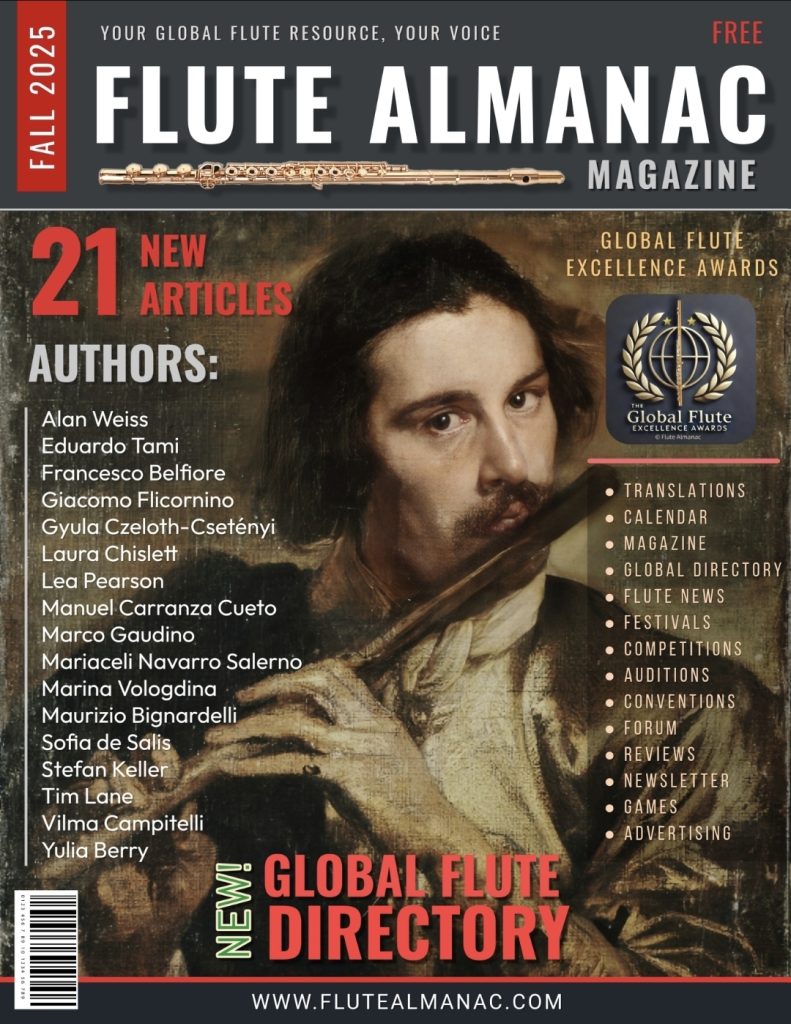
In this edition:
The Flute Almanac Directory: The Global Future of the Flute World
by Flute Almanac
With the launch of the Flute Almanac Directory, the flute community finally has what it has long been missing: a centralized, professional, and global hub connecting flutists, teachers, makers, ensembles, composers, festivals, institutions, and researchers.
Unlike social media, which buries important content under algorithms and distractions, the Directory provides a permanent, searchable, and instantly translatable record of the flute world. It levels the playing field, giving equal visibility to a teacher in a small town and a celebrated soloist on the world stage, while simultaneously creating a historical archive of our community for future generations.
More than a database, it is a collective identity for flutists worldwide, ensuring that artistry, innovation, and collaboration are seen and remembered. In this article, Flute Almanac introduces the vision, features, and impact of this groundbreaking platform — a resource that redefines how the global flute community connects and thrives.
When Music Saves Lives: The Flute and Arn Chorn-Pond
by Flute Almanac
Few stories demonstrate the life-saving power of music more vividly than that of Arn Chorn-Pond. As a child in Cambodia during the Khmer Rouge regime, Arn survived the horrors of a killing camp by playing the flute — a fragile lifeline that spared him from execution and gave him hope amid despair.
In this article, Flute Almanac recounts his remarkable journey from genocide survivor to cultural activist, tracing how music not only preserved his life but also became the foundation for rebuilding Cambodia’s artistic traditions. His story is interwoven with that of other survivors, such as pianist Alice Herz-Sommer, who likewise turned to music as a means of endurance.
A Flute Buying Guide
by Alan Weiss (USA)
In this comprehensive guide, Alan Weiss explores the pros and cons of buying new versus vintage flutes, weighing financial considerations, sound quality, and craftsmanship. He explains why pre-owned instruments — particularly vintage Boston-made French model flutes — can offer exceptional value, character, and projection compared to expensive modern options.
Drawing on decades of performing, teaching, and flute expertise, Weiss shares insights into pitch, intonation, mechanisms, and the unique history behind older instruments, helping flutists make informed choices when investing in their next flute.
Working on “Café 1930” – Part II
by Eduardo Tami (Argentina)
In this continuation of his detailed study of Piazzolla’s Café 1930, Eduardo Tami guides readers through the section beginning at measure 31, where the character shifts from lyrical melancholy to rhythmic energy. He shares practical insights into phrasing, rhythmic variation, the use of glissandi and gruppetti, and expressive resources rooted in tango tradition.
Eduardo Tami emphasizes adapting Piazzolla’s aesthetic to the flute rather than imitating the bandoneón directly, offering performers ways to enrich their interpretation while remaining true to the spirit of the music.
Reconstructing a Practice Session in the 1750’s
by Francesco Belfiore (Italy)
What did it mean to “practice” in the mid-18th century? Francesco Belfiore brings this question vividly to life, reconstructing the daily routine of a young flutist in 1745. Guided by the writings of Quantz, Hotteterre, Leopold Mozart, Mattheson, Geminiani, Heinichen, and Tosi, he shows that practice in the 1750’s was not a matter of hours logged or scales repeated, but a philosophical, rhetorical, and expressive exercise.
The article traces key themes: the integration of mind and ear as much as fingers; the insistence on variety rather than mechanical repetition; the primacy of affect and rhetorical expression over empty virtuosity; and the importance of silence, rest, and reflection. Belfiore translates these principles into a modern reconstruction, from tone rituals shaped by vowels, to spoken articulation, affective scales, ornament experiments, rhetorical pieces, and reflective “cool-downs.”
Two Worlds, One Flute: The Circuit of Harmony and the Circuit of Power
by Giacomo Flicornino (Italy)
In this thought-provoking article, Giacomo Flicornino contrasts two imagined “circuits” of the flute world: the Circuito Armonico, where collaboration, sincerity, and artistic authenticity thrive, and the Circuito Dorato, where exclusivity, competition, and power dynamics dominate. Through vivid descriptions, he highlights how different attitudes toward teaching, competitions, and recognition shape the experience of flutists and the health of the musical community at large.
Ultimately, Flicornino reminds us that the flute, with its ancient connection to the human breath, deserves to serve as a bridge of communication and inspiration rather than a tool of control. This article is both a reflection and a call to musicians to choose the path of openness, humility, and true artistry.
A Hungarian Nobleman Who Played the Tsakan
by Gyula Czeloth-Csetényi (Hungary)
Gyula Czeloth-Csetényi offers a fascinating exploration of the tsakan (csakan or csákány), a once-popular 19th-century instrument that straddled the line between walking stick, weapon, and flute. At the center of this history stands Count István Széchenyi (1791–1860), celebrated statesman, reformer, and one of Hungary’s most influential figures. Known as “the Greatest Hungarian,” Széchenyi was also an amateur musician who found solace in the tsakán, particularly during periods of deep personal and political turmoil.
This article traces the instrument’s rise in Vienna and Pest-Buda, its repertoire composed by Heberle, Krähmer, Diabelli, and others, and its symbolic role in Széchenyi’s life. With rich historical context and musical detail, Czeloth-Csetényi shows how an almost forgotten instrument became both a companion in private struggle and a bridge between Hungary’s cultural legacy and European music history.
To Click, Or Not To Click?
by Laura Chislett (Australia)
In this insightful article, Australian flutist Laura Chislett explores the fascinating world of key clicks — one of the earliest extended techniques for flute, first notated by Edgard Varèse in Density 21.5 (1936). Since then, composers such as Berio, Ferneyhough, and Takemitsu have expanded the technique into powerful percussive gestures, but not without challenges.
Laura Chislett outlines the practical realities for performers: the physical demands of finger height and coordination, the limitations of speed and clarity, the problem of rebound sounds, and the risk of damage to pads and mechanisms. She also highlights alternatives such as tongue and lip pizzicati, which can achieve similar dramatic effects with greater efficiency.
Unlocking Ease and Expression: How Somatic Inquiry Transforms Practicing and Teaching
by Lea Pearson (USA)

In this powerful and practical article, Dr. Lea Pearson introduces musicians to the transformative concept of somatic inquiry – a process of exploring the inseparable connection between body, mind, and emotion in music-making. Drawing on decades of experience as a performer, educator, and Body Mapping specialist, she explains how curiosity, awareness, and self-compassion can replace frustration, tension, and self-criticism in both practice and teaching. Dr. Pearson guides readers through somatic approaches to mastering difficult passages, deepening artistic expression, and developing effective warm-ups, while also addressing the emotional weight of judgment and performance anxiety.
For teachers, she offers concrete strategies to create empowering lessons that build resilience and artistry in students of every level. This article is both an invitation and a toolkit: a call to musicians to rediscover ease, freedom, and authenticity in their playing and teaching.
“Ancestral Warriors”: A New Latin American Flute Concerto by Peruvian Composer Daniel Cueto
by Manuel Carranza (Peru)
Peruvian flutist and composer Daniel Cueto has created a powerful new addition to the Latin American concerto repertoire with his Concierto para flauta y orquesta de cuerdas No. 1 “Relato Chimú”, later revised and retitled “Ancestral Warriors”. Inspired by the pre-Inca Chimú civilization, the work transforms history into sound, weaving a dramatic narrative of ritual, confrontation, and resilience. Premiered in Lima in 2019, the concerto unfolds in a single continuous movement, with the flute as its central narrator — guiding the listener through landscapes of tension, battle, and spiritual reflection.
In this article, Manuel Carranza sets Cueto’s concerto within the broader history of the flute concerto, from the Baroque masters through Romantic virtuosi to the innovations of the 20th and 21st centuries. He highlights how “Ancestral Warriors” bridges global contemporary practice with deeply rooted Andean identity, offering flutists worldwide a unique opportunity to engage with Peru’s cultural heritage through music. Daniel Cueto’s concerto is not only technically challenging and emotionally compelling, but also a vital contribution to the visibility of Latin American voices in the global flute repertoire.
International Research on Vocal Cord Behavior in Flute and Wind Instrument Techniques: Illustrations and Personal Reflections – Part II
by Marco Gaudino (Italy)
In this second installment of his research series, Marco Gaudino explores groundbreaking international studies on the role of the vocal cords, glottis, and pharyngeal muscles in the production of sound on wind instruments, with a special focus on the flute. Drawing from the pioneering experiments of Charles O. Veazey, the investigations of Claudia Alessandra Eckley in Brazil, and the advanced imaging research led by Claudia Spahn and colleagues in Germany, Gaudino weaves together scientific findings with his own pedagogical insights.
The article underscores how subtle physiological mechanisms — such as glottic opening, tongue positioning, or unwanted muscular tension — can profoundly affect sound quality, intonation, and even the long-term health of performers. With clarity and depth, Marco Gaudino not only contextualizes these results but also emphasizes their practical value for teachers and students, urging a balance between anatomical awareness and musical freedom.
Focal Dystonia in Musicians
by Mariaceli Navarro Salerno (Venezuela)
In this deeply personal and courageous article, Venezuelan piccolist Mariaceli Navarro Salerno shares her journey with focal dystonia — a neurological disorder that disrupts motor control and has affected many professional musicians in silence. Through her own story of diagnosis, emotional impact, and recovery strategies, she brings awareness to a condition still considered taboo in the music world.
Mariaceli offers insights into therapies, holistic approaches, books, and personal practices that helped her regain up to 90% of her playing ability, while reminding musicians that patience, creativity, and multidisciplinary care are essential. Her testimony is both a beacon of hope and a practical guide for flutists and instrumentalists facing this challenging condition.
First Steps of Young Flutists. Part II
by Marina Vologdina (Russia)
In this continuation of her pedagogical series, Marina Vologdina turns her attention to one of the most critical stages in a young flutist’s development: posture, hand position, and the gradual mastery of fingerings. With clarity and experience, she highlights common mistakes that children often make when holding the flute, the importance of parental support during home practice, and the role of proper posture in sound, intonation, and breathing.
Marina Vologdina explains how to introduce the first notes, stresses the need for patience in learning fingerings, and emphasizes the dangers of ingrained bad habits that can affect both tone and technique for years to come. This insightful article offers teachers and parents alike practical advice for guiding beginners toward healthy, effective, and enjoyable flute playing.
Emanuele Krakamp and the Advanced Flute Course Op. 43
by Maurizio Bignardelli (Italy)
Emanuele Krakamp (1813–1883) stands as one of the central figures of 19th-century Italian flute playing, renowned for his technical brilliance, prolific output, and patriotic career. Among his many contributions, the monumental Corso di Perfezionamento Op. 43 — over 300 pages of preludes, scales, and demanding exercises in every key — represents the pinnacle of his pedagogical vision.
Maurizio Bignardelli traces Krakamp’s journey as an international concert artist, his involvement in the Risorgimento, his rivalry with contemporaries, and his eventual embrace of the Boehm flute. This study not only illuminates Krakamp’s achievements but also reflects on the decline of his bravura style as Italy’s musical culture shifted after unification.
A Universal Platform for the Flute: Yulia Berry’s Vision
Interview by Sofia de Salis (Switzerland)
This interview profiles flutist-educator Yulia Berry and her fast-growing “universal platform” for the flute world: Flute Almanac (a multilingual global magazine), the Global Flute Excellence Awards (recognition across performance, teaching, making, and advocacy), and the Global Flute Almanac Directory (a curated, prestigious, worldwide “Who’s Who”).
Yulia Berry traces her path from conservatory training and early tech projects to building a connected ecosystem that archives culture, elevates excellence without rivalry, and removes language and geographic barriers. She shares how reader impact, open nominations, and accessible listings fuel inclusion and visibility – aiming to reshape the flute community into a globally linked network of knowledge, recognition, and opportunity.
FLAUTANDO Boswil 2026 – The Magic of the Flute
by Stefan Keller (Switzerland)
Held at the historic Künstlerhaus Boswil in Switzerland, often called the “home of the flute,” FLAUTANDO Boswil is one of Europe’s most cherished flute gatherings. The 2026 edition marks the twenty-sixth celebration of this international event, with workshops, exhibitions, and a master concert that highlight the instrument’s versatility — from piccolo to contrabass flute.
With contributions from world-renowned artists such as Gudrun Hinze, Philipp Jundt, Tilmann Dehnhard, Gareth McLearnon, and Stefan Keller, this festival continues the tradition begun by Marcel Moyse’s legendary masterclasses. Its program blends innovation with heritage, offering flutists an inspiring meeting point where artistry, pedagogy, and community converge.
The Case for Introducing More Variety into Performances of the D-Major Flute Concerto K 314/285d by Wolfgang Amadeus Mozart
by Timothy Lane (USA)
In this scholarly and performance-oriented article, Timothy Lane makes the case for reviving forgotten stylistic features in Mozart’s D-Major Flute Concerto. Drawing on 18th-century sources such as Koch and Türk, he highlights the Classical aesthetic of “unity and variety” and its practical implications for tempo, dynamics, articulation, and phrasing. Lane argues that by reintroducing expressive contrasts and historical performance practices, flutists can bring out the concerto’s rich interplay of Galant and Classical styles, offering audiences a fresher, more authentic perspective on one of Mozart’s most beloved works.
Mélanie Hélène Bonis, known as Mel Bonis: A Legendary Composer (France, 1858–1937)
by Vilma Campitelli (Italy)
This feature traces the remarkable life and legacy of Mélanie “Mel” Bonis – pupil of César Franck and contemporary of Debussy – who adopted a gender-neutral pseudonym to publish more than 300 works spanning piano, voice, chamber, orchestral, and sacred music. Set against Paris’s “Second Golden Age” of the flute, it follows Bonis from her strict Catholic upbringing and meteoric Conservatoire years to a marriage that sidelined her career, a hidden love with singer-critic Amedée Hettich, and the secret birth of their daughter, Madeleine.
Vilma Campitelli details the later rediscovery of Bonis through family archives and scholarship, and highlights her flute output (including the Sonata in C♯ minor, Op. 64, dedicated to Louis Fleury; Suite Orientale; Scènes de la forêt; and more). Blending post-Romantic lyricism with hints of Impressionism and cyclical form inherited from Franck, Bonis’s music emerges as a vital bridge long overlooked – now reclaiming its place in the repertoire.
The Lost Art of Musical Etiquette: Why Manners Matter for Musicians and Students
by Yulia Berry (USA)
In this insightful article, Yulia Berry explores why etiquette remains a cornerstone of music education and performance. Far from being old-fashioned, good manners create an atmosphere of respect between teachers, students, audiences, and colleagues – enabling artistry to flourish.
Yulia Berry discusses gratitude as the first lesson, performance etiquette on and off stage, scientific research on how concerts physiologically connect us, and the silent power of dress and presence. She also addresses modern challenges such as mobile phones in concert halls, showing that etiquette is not restrictive but empowering, shaping both professionalism and community in music.
Album Review: Niccolò Dôthel – Sonates pour une Flûte Traversiere et un Violoncelle, Opus II
Performed by Tim Lane (flute) and Tulio Rondón (cello)
by Flute Almanac
This beautifully crafted review brings long-overdue attention to Niccolò Dôthel (1721–1800), a forgotten yet highly respected 18th-century flutist-composer. Dôthel, once a central figure of Florentine musical life, left behind a vast legacy of flute works, but his name has faded from today’s concert stages. With this new recording, flutist Tim Lane and cellist Tulio Rondón reintroduce his six Sonates, Op. II – works that sparkle with lyrical charm, stylistic elegance, and an unusual balance between flute and cello.
More than just a performance, this recording represents a rediscovery of an overlooked repertoire, offering performers and listeners a chance to engage with music that bridges French finesse and Italian flair. The result is essential listening for anyone passionate about the flute, chamber music, or uncovering hidden treasures of the 18th century.
As we celebrate one year of Flute Almanac and open the doors to the Global Flute Directory, this Fall issue is both a snapshot of where we are and an invitation to where we can go together.
Read widely, share generously, and add your voice: claim or create your Directory listing, send us your news and research, and prepare your submissions for the 2nd Global Flute Excellence Awards (opening December 1).
To every author, artist, maker, educator, and reader across 252 countries – thank you for shaping this living archive of our art!